
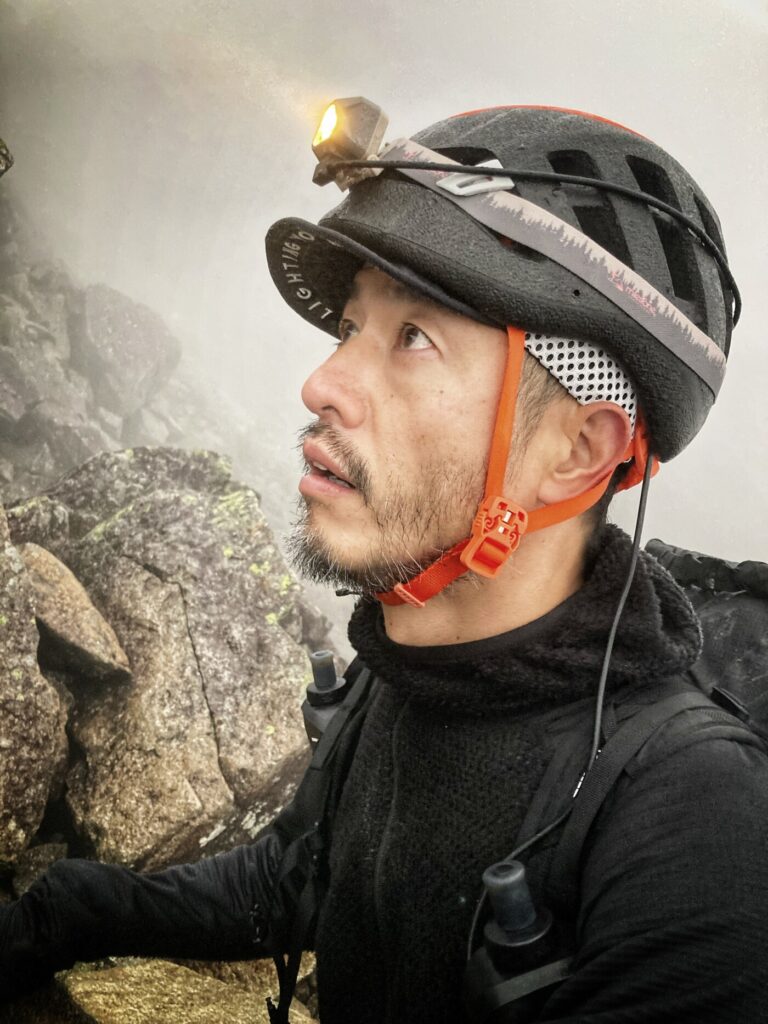
This series is a project in which Hagiwara (who runs with him in #WednesdayBudouzakaRen) listens to the stories of two people who have created milestone items (founder Nishioka) and used them (mid-career hire Yoshida) and delves into them.
・Features of the newly released headlamps "MS-G3" and "MS-G4"
Hagiwara (hereinafter H): Headlamps were introduced in the first episode of "Oshi! My" (short for "Oshiete! Milestone") , but this time we'd like to hear more about the new products "MS-G3" and "MS-G4" that will be released.
Right off the bat, what was the "G" in your name?
Nishioka (hereinafter N): They're lined up there (milestone TERADACHO, second floor window side), but there are three models that were first released in 2014, and each model has a different name: the MS-A series (single AA battery type), the B series (three AAA battery types), and the C series (four AA battery types).

The D series, released the following year, is a lantern. The E series is a separate type with the battery attached at the back. The MS-F1: Trail Master, developed by Doi-san, is followed by the G series, which we'll introduce today. The H series is a hybrid model that can be used with both dry batteries and rechargeable batteries. Finally, the MS-i1 is an endurance model with long-lasting lighting that is used in many fields by trail runners and hikers. The next handheld light to be released is the J1, and so on, with the series all listed in alphabetical order.
Yoshida (hereinafter Y): So you've already released 10 series.
N: Once we get to Z, we'll have to think about the next step. There are 26 letters in the alphabet, so there are only 16 left, so I think we'll be fine until around 2026.
Y: We'll have to work really hard on development (laughs).
N: Jokes aside (laughs), the MS-G series is a compact, USB-rechargeable model that's extremely lightweight. The MS-G1 (discontinued model) was a simple, easy-to-use, and affordable 300-lumen model. The next model to be released was the MS-G2 . It's incredibly bright with a wide beam angle of 400 lumens, and is a multi-function model that lets you choose from a variety of lighting patterns, including white, warm white, red, flashing red, and mixed light.

H: It doesn't look like a light.
N: You can see a row of square chips, but they're actually not LEDs but SMDs (Surface Mount Devices), which are a type of LED, and by making them this shape they can emit light over a wide angle. However, the downside is that they can only illuminate a distance of about 30 meters.
On the other hand, the newly released MS-G3 and MS-G4 have a narrower beam angle, allowing for spot illumination that can reach farther. That's why the successors to the G1 are actually the MS-G3 and MS-G4.

One of the upgrades is that the charging method has changed from USB Type B to Type C. This is also changing with the times, and is now increasingly being changed to Type C. By switching to Type C, so-called fast charging is now possible.
N: Another thing is that you can use it while charging. In the case of the G2, it can last up to two hours at 400 lumens. That's because the battery has a capacity of 600mA (milliamperes), and it turns off when the battery runs out. The biggest advantage of these (G3, G4) is that even if the battery runs out, you can still use it while charging by connecting an L-shaped cable to the battery (MS-LB3: smart mobile battery) used in the MS-i1.

The L-shaped cable that was released at the same time is, as the name suggests, L-shaped, making it easy to use while plugged in. With a regular cable, it hangs down in front of your face. Not everyone needs it, so we've sold it separately .

Y: However, when using it while charging, the brightness will be 10%. The maximum brightness for the MS-G3 is 420 lumens, so it will be 42 lumens.
H: If you don't lower the output, the charge won't build up.
Y: I went on a non-stop test of the Takashima Trail (an approximately 80km long trail in Takashima City, Shiga Prefecture) to see if I could really traverse it using just the MS-G3. Everyone else was using the MS-i1, but instead I brought two MS-LB3 batteries.
H: It seems like a physically demanding mountain climb.
Y: In the end, I kept charging it all night and continued walking, but I was able to complete the traverse without any problems. However, the weather was bad, and it was so cold that my fingers got numb (laughs).
N: The MS-LB3 is Type C, but if you have a conversion adapter, you can use either Type A or Type B. However, we recommend our own battery.

Y: There are rare cases where the customer's battery won't charge, but the genuine battery will. It's just a matter of compatibility. So I recommend using the genuine battery.
Also, the battery weighs only about 50g, but it's exposed to keep it light. Therefore, the cable jack is not waterproof, so you don't want it to get wet. If it gets too wet, it may still work, but it could rust.
So, I would like them to be able to put it in a ziplock bag or make it waterproof. I myself put my spare battery, which is essential for trail races, in a part of my backpack where it gets wet with sweat, and one of them was ruined. This is something to be careful about.
・Darkness attractions
H: What is the difference between G3 and G4?
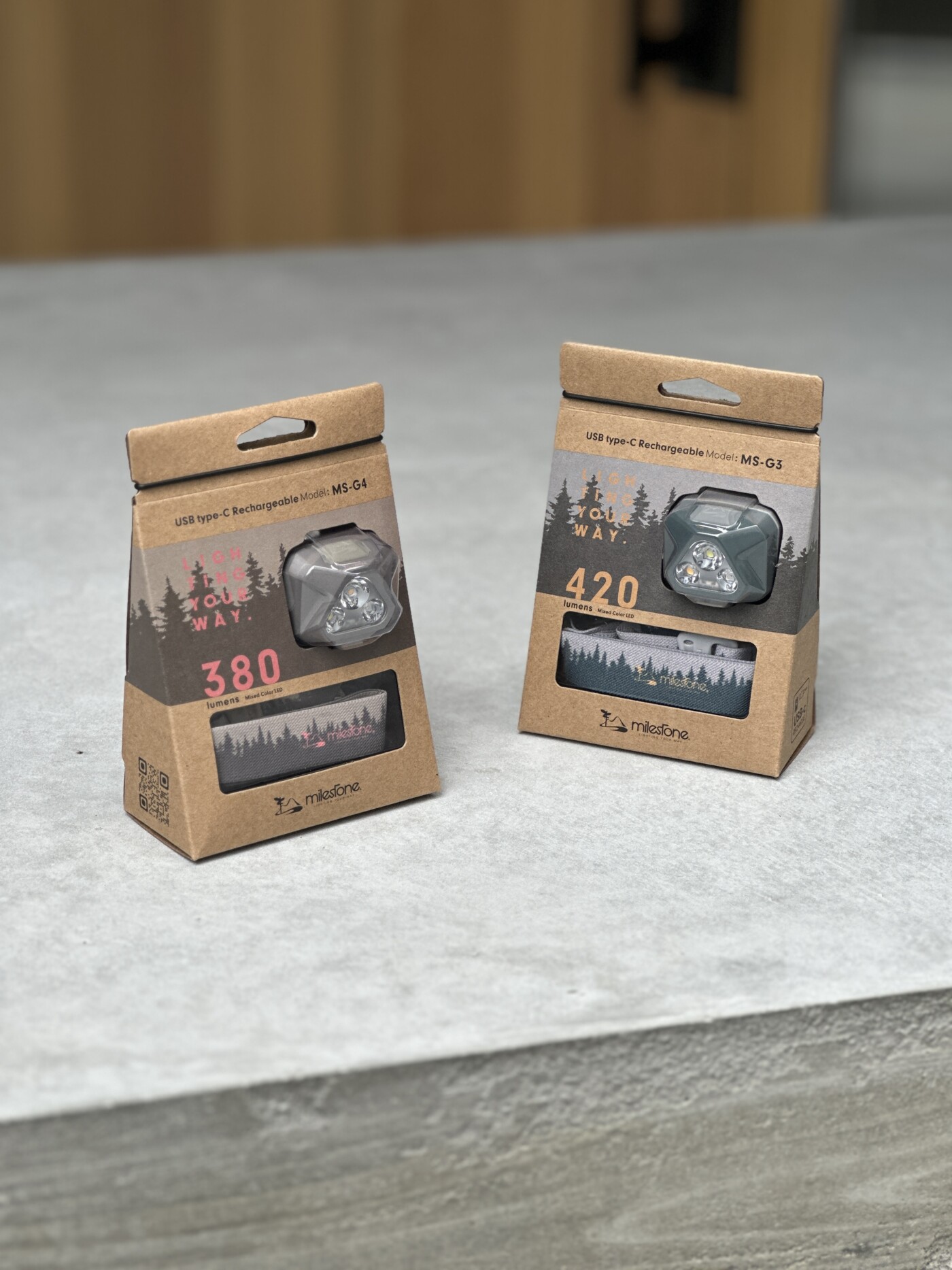
N: The MS-G3 mainly uses white LEDs and has a brightness of 420 lumens.

The MS-G4 has a brightness of 380 lumens and is primarily a warm white light, which is the color that Milestone recommends.

I have white, warm white, and red sub LEDs, so it's just a matter of choosing which one to use for the main LED . The color of the main body is also a matter of preference, whether it's blue or brown.
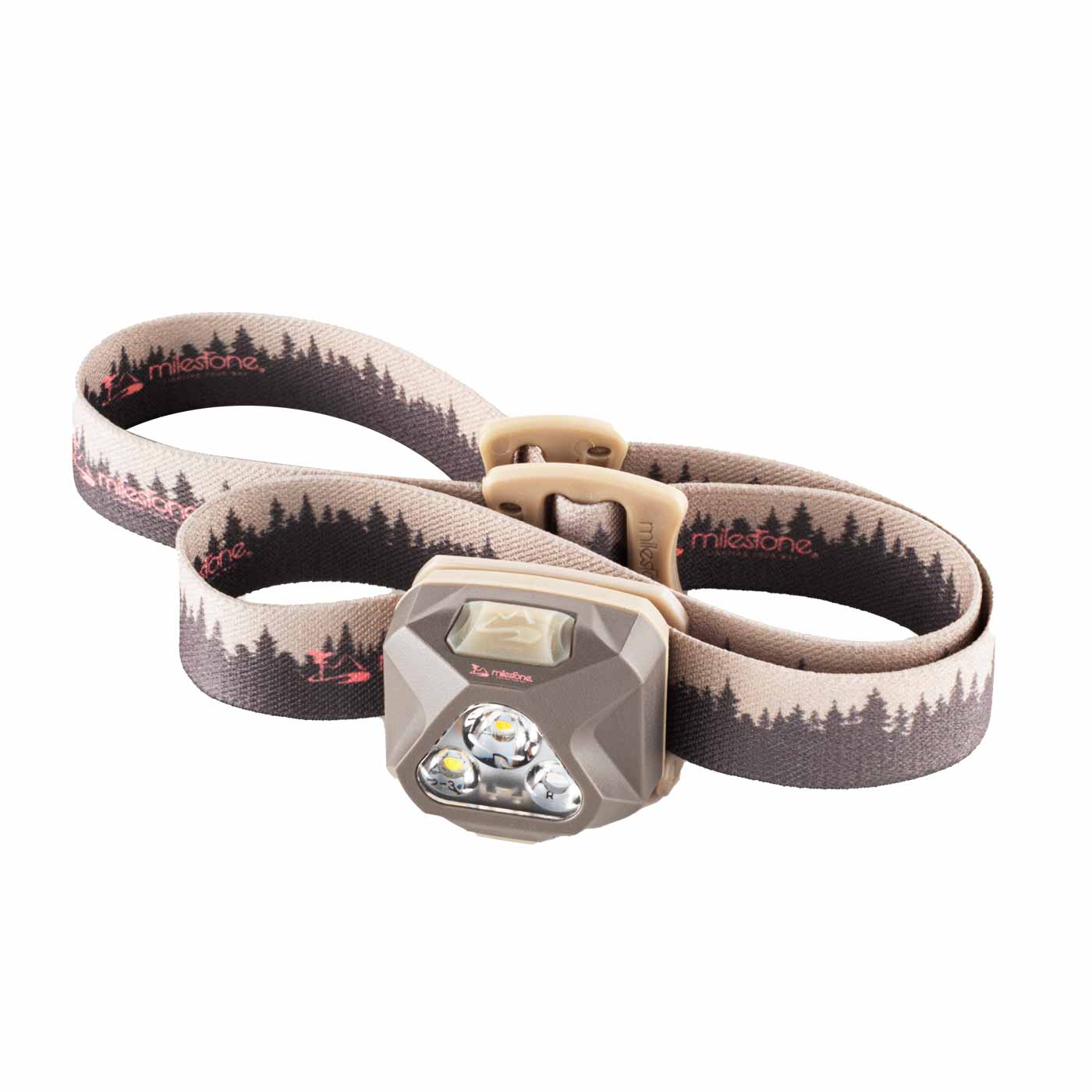
You can adjust the brightness by pressing and holding the main or sub light button while it is on, and lock it by pressing and holding it when it is off. This prevents accidental activation inside your backpack.
Y: Just to recap, why is Milestone doing the incandescent color? Why did they go to the trouble of making two identical ones for G3 and G4?
N: As we mentioned in the first episode of "Oshi! Mai," milestone is a latecomer to the headlamp industry. With PETZL, Black Diamond, LEDLENZER, and others, we were trying to figure out how to break into the market, and we decided to make ours incandescent light bulb color to set ourselves apart.

However, to win the lumen war, which is all about brightness, it's not easy to get customers to buy in with just saying, "Ours is incandescent white." That's why we're offering two models: the MS-G3, which uses white LEDs that prioritize brightness, and the MS-G4, which continues the incandescent white style.
The good thing about the warm white color is that it allows light to pass through easily when fog appears, and warm white has better light transmittance than white.
H: What do you mean by light leakage?
N: If you shine white light on foggy areas, it will reflect off the white water vapor, but if you use incandescent light, the light will filter through, allowing you to see clearly.
H: There's a place where you can try out the difference between incandescent and white.
N: That's right (laughs). As I mentioned in the 6th episode of "Oshi! Mai," if you come to milestone TERADACHO, there is a Dark Room where you can experience a simulated trail walk. We create fog with a smoke machine, and you can experience what it looks like when you're actually in fog, as well as the difference between white and incandescent light.

Y: Everyone really enjoys it. After I explain the difference between the lights in the dark, a bar of mist appears and they're like, "Wow, that's amazing!" In my previous job, I worked at a theme park, and the customers who came out of the rides would look the same as they did (laughs).
N : I often hear people say that the incandescent light has helped them during races, so I hope you will come and experience it for yourself.
To be continued in the second part
Episode 6: Tell me! Milestone "Milestone that became a map" Part 2
Episode 7: Tell Me! Milestone "What's G?" Part 2