

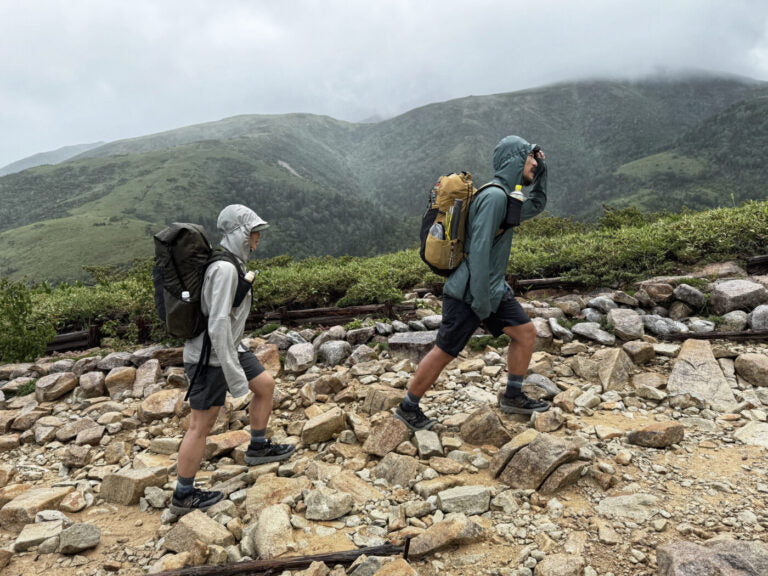
This series is a fictional podcast show in which writer Hagiwara (who met three people, Nishioka, Yoshida, and Haruka, on #WednesdayBudouzakaRen) delves into various topics related to milestones.

・Why we buy Rain
Hagiwara (hereinafter Hagi): It's time for "Oshi! Mai." What will you be teaching us today?
Nishioka (hereinafter, Nishi): We're talking rainwear and windshells, but let's start by talking about the Up-Swing Rain Hoody.

Hagi: It was released in January of this year. Is it on schedule to re-release it after only eight months?
Yoshida (hereinafter Yoshi): To be honest, we misjudged the production quantities (laughs). It's difficult to get the exact quantity right for any item. We thought we had a year's worth of stock, but it was almost all gone in about two months.
Omori (hereinafter, Haruka): Thank you!
Hagi: Just because something is out of stock doesn't mean we can make it right away.
Nishi: This raincoat is made from scratch. The fabric is custom-made, so it takes time.

Yoshi: We don't use fabric that fabric manufacturers have in stock. We start by weaving the thread, creating the raw fabric, and then dyeing it in our original colors. If we were just sewing it, it would be a little quicker.

Nishi: Rain has a three-layer structure, so it takes time to align them. The product that we created, betting the company's future on, has received a better response than we expected. Of course, we worked hard hoping that it would turn out that way, but it's frustrating that it's out of stock now. We'll have it up by the end of August and it should be swinging (laughs) . *Note: It was just recently restocked and is swinging right away.
Hagi: The waterproof and breathable functions and structure of rain gear were discussed in detail in episode 25, "Things that lift your spirits in the rain," so I'd recommend checking that out for more details. Can you just explain the basics as a recap?
Haruka: It's what's known as 3-layer rainwear. The outer layer is 20D (denier), the lining is 7D, and the middle membrane is a hydrophilic non-porous membrane.

It has a breathability of approximately 40,000 g/m² and a water resistance of approximately 30,000 mm. A distinctive feature of the pattern is the tucks in the back, which allow you to put it on over your trail running backpack. The hood has a wired brim and is packable, making it a rain jacket packed with all the essential elements for trail running.

Nishi: What do you think of using Hagi?
Hagi: Actually, I haven't bought it yet (laughs). I've tried it on many times and I know it's good because it's light and stretchy, but unlike shoes or backpacks, rainwear isn't something you use every day, and the set of top and bottom is quite expensive. While I was thinking about what color to get, it was all gone (laughs). I think I'll finally need to buy new ones in preparation for the Shinetsu Five Mountains climb in September, so I'd like one more push (laughs).
Yoshi: This might sound like the opposite of what I'm saying, but there's something I've been thinking about lately while serving customers. It's the same with headlamps, but I'm often asked, "If I had this, could I go anywhere?" But it really depends on what you want to do and what you're playing with. For example, in terms of cars, taking a Ferrari that can go 400 km/h into the mountains would be useless. It's also not right to drive a Land Cruiser on a circuit. First of all, it's hard to recommend something unless you're sure how you'll use it.
Hagi: But it's an expensive purchase, so I want something versatile that I can use anywhere (laughs).
Yoshi: I understand that. But if you go to a snowy mountain wearing this, you'll probably freeze, and if you're stuck and exposed to the rain for a long time, there's a risk of hypothermia even if you're wearing this rain gear. We designed this rain gear primarily with trail running races in mind. I don't think there'll be any problems wearing it in a race. But if you expand the range of use to include not only races but also fast running, there will be some discrepancies. No matter what kind of gear it is.
Haruka: When it comes to headlamps, the MS-i1 isn't necessarily superior in every way, depending on the situation.

Yoshi: It's the same with UL (ultralight) gear, but it's not right to say that everything should be UL and light.
Hagi: So when using tools, you need to be able to judge them based on experience. There are also individual differences and the environment on the day.
Yoshi: I felt this especially when we released the Up-Swing Rain Hoody and Rain Pants.
Hagi: Well, it's important to hear directly from people who use it before you buy it. Haruka-chan also named it a best buy in her review of the first half of this year.
Haruka: I wore it when I got caught in the rain on the TDT100, the Omine Oku-Kado Trail, and during a company training session in the Northern Alps last month. It served not only as rain gear but also as cold weather gear, so it served two purposes.

Nishi: If you say so, it's not just rain gear, it also serves as a wind shell. When I participate in a trail running race, a rain gear is a must-have, so I bring it with me, but it's nice not to have to carry a separate wind shell. I'll talk about wind shells later, though (laughs).
Yoshi: Compared to the Rain, the Onion Hoody is about 50 grams lighter.
Hagi: It's a difference that can be substituted, right?
Nishi: I think it's rainwear that can be worn on sunny days. It's stretchy and easy to move in.
Haruka: The double zipper allows you to regulate your body temperature, and it's breathable so it's not uncomfortable.
Yoshi: Yes, you can sleep in them. The fabric is soft and doesn't rustle. When I went to the Northern Alps for employee training, the only long pants I brought were the Up-Swing Rain Pants. So I wore them at the campsite, and even when it wasn't raining, I used them as both a cold weather jacket and pajamas.
Hagi: Pajamas, to my surprise (laughs)
Yoshi: Of course, if you get wet in the rain for hours, it gets soggy, but it's warm when you wear it.
・New onion colors?
Hagi: Rain gear is a must-have item for races and high mountains, but when training nearby, a wind shell is often enough. By the way, I'm pushing the idea that it's convenient to have two wind shells.
Haruka: What do you mean?
Hagi: If you wear it while running, it will get wet with sweat, so it's often convenient to have another one with you as a change of clothes or to use after going to the public bath. It's also compact.
Yoshi: If you've heard that theory, we have good news for you. The Onion Hoody is coming out in new colors.
Hagi: Unfortunately, I already have two black and white ones. There have been many different colors up until now.
Nishi: The three standard colors are solid black, polar white, and British green. The seasonal colors are sunset yellow, storm blue, and California orange, which were relatively bright colors, but the new colors are royal navy and ash gray.

Haruka: This time I deliberately went with muted colors.
Nishi: I don't really wear navy very often.
Hagi: I remember hearing that a few times before (laughs).
Nishi: That's why I thought maybe we didn't need to make navy (laughs), but Natty Shorts 5_inch "PLUS" also comes in dark navy, so I thought navy might be good too. It's a lighter color than I thought it would be.


Hagi: That's true. You could even say it's a slightly darker blue.
Nishi: The gray also looks a bit brown to me. A warm gray, perhaps.
Hagi: Gray is a nice color.


Nishi: Onion has been around for four years without changing the dough or shape. I would like to continue making things like this that will become classics.
Hagi: It's a classic item that everyone knows about, but if you haven't read it yet, you can read the first and second parts of Episode 4, "Is the World an Onion?", where we talk about the product development process.
Haruka: Let me just recap the basic features: non-stick fabric, double zipper, watch windows and thumbholes on both arms.

It's packable and fits perfectly in the back pocket of my Natty Shorts 5 inch.

Hagi: Personally, I think a wider width is good. For example, with a certain company's wind shell, the S size is the perfect fit for length and sleeve length, with a width of 52cm. With Onion, the M size is the perfect fit, with a width of 58.5cm. I appreciate being able to wear it over a backpack.
Haruka: I used to wear them a lot for winter running even before I joined the company. They have ventilation on the back and sides, and I think they're well thought out. The diagonal zipper design also started here.
Nishi: You can tell just by looking at it, and I like that there's a difference.
Yoshi: I think the double zipper is the best. Nishioka-san was still a novice when he decided to make this, but he said he definitely wanted a double zipper.

Hagi: It's essential for regulating body temperature.
Yoshi: I also use the watch window when it's cold.
Hagi: Especially during marathon training in the winter, when I'm doing interval runs, I want to keep an eye on my watch.
Nishi: It has both a right and left side. The product name was good.
Yoshi: I'm impressed that you thought of it that way.
Nishi: That's right. Was it my idea?
Yoshi: No, it was me (laughs). This is when we decided on the name. We decided to go with music.
Haruka: Did you have a lot of ideas?
Yoshi: I was almost like Master Blaster Hoodie (laughs) but I hadn't joined the company yet. When I think of milestones, I think of Nishioka Shuhei. Nishioka Shuhei is all about music, after all. I wanted to take it from music. And not from a modern song, but from something that never goes out of style. "Natty" from Bob Marley, and "Onion" from Marvin Gaye.
Nishi: I was pressing Master Blaster, but it was too long so I gave up (laughs).
Yoshi: Looking back at our past LINE messages, I've been pushing back on Onion quite a bit.
Haruka: At first it was called "The Onion Song," so it had the "The" in it, but that disappeared before you knew it.
Nishi: Seriously (laughs). Yoshi said, "When I think that it's almost finished, I start crying. It's just an onion."
Haruka: That's a good point. I'll make a note of it.
Hagi: Well, that's all for today.
Nishi, Yoshi, Haruka, Hagi: Goodbye, goodbye, goodbye.
There are basically no restrictions on what clothes you can wear in the city. You are free to dress however you like. But it's different in the mountains. Clothing needs to be functional to protect you from the external environment. For example, rainwear needs to be waterproof and breathable to protect you from the rain, and have a pattern that allows for easy movement. You could call it "tool" for the activity. But that doesn't mean it's 100% tool. Color and design are not necessarily limited to functionality. There is freedom in "restrictions."
These "constraints" change depending on the activity. Trail running and hiking produce different amounts of sweat, and the clothing you need changes when you go into a stream. The same goes for cycling. There is different gear specialized for each activity.
However, depending on how you carry out your activities, or how you combine them, infinite variations can be created. New "restrictions" encourage creators to develop new "tools."
How you choose and combine these items is also up to you, and I think that's what makes outdoor wear so interesting.
Text and composition: Ken Hagiwara
Share :
Episode 31: Tell me! Milestone "Is it necessary or unnecessary?"
Episode 33: Tell Me! Milestone "What Signals the End of Summer"