

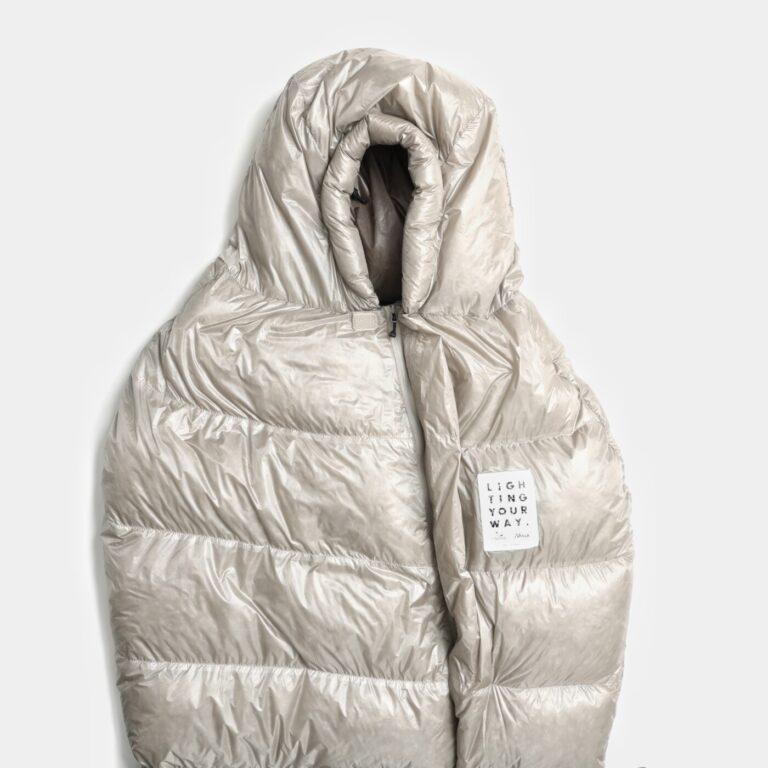
This series is a project in which Hagiwara, who runs with the duo (Nishioka & Yoshida) who created the milestone items, listens to them and delves deeper into their stories (as he runs with them on #WednesdayBudouzakaRen).
・Special collaboration
Nishioka (hereinafter, Nishi): Today we'd like to introduce you to a special product that's different from usual.
Hagiwara (hereinafter, Hagi): What do you mean?
Nishi: We have decided to collaborate with NANGA®︎ .

Yoshida (hereinafter Yoshi): It's a Japanese down manufacturer that is so well-known that everyone knows about it.
Nishi: We make a lot of down jackets, but this time we had a special sleeping bag made. It will be sold exclusively at milestone TERADACHO and our official online store .
Hagi: A sleeping bag from milestone ?! How did the collaboration come about?
Nishi: We've been in contact with Nanga since milestone was founded. The Yokota brothers (laughs) are the president and vice president, and although the scale of the company is different, it's run by brothers, just like our company.

At the NANGA 30th Anniversary Party Left: President Tomoyuki, Right: Vice President Keizo
Hagi: Wow.
Nishi: My father is the chairman, and his predecessor was the founder. So we feel very close. I've had the opportunity to meet him at events, and I get along particularly well with his younger brother, Keizo. We go out for drinks and talk about our dreams for the future. In fact, we collaborated with NANGA two years ago. We combined our headlamps with NANGA's belt to create a " NANGA x milestone" headlamp. It would be great if a milestone headlamp could reach a NANGA customer.


Hagi: So that's what happened.
Nishi: I'd always wanted to do a reverse version of " milestone x NANGA," but I'd always been searching for what I could do. If you trace NANGA's roots back to its origins, it was a futon manufacturer, so we've always wanted to cherish those roots, and I wondered if we could incorporate something like a sleeping bag into our style.
Milestone is celebrating its 10th anniversary this year. I wanted to do something special, so I called Vice President Keizo and told him I wanted to do something. He said, "Just tell me! I'll do anything!" He's a really easy-going and friendly guy, so I said, "I'll do it right away! I'll come right now!" and he actually came over (laughs). So I told him that I wanted to base it on a model called MINIMARHYTHM within NANGA.
Yoshi: NANGA offers a wide range of products, from models for car camping to those for severe winters, but we chose the MINIMARHYTHM as our base because it was the lightest model that could be used in three seasons (spring, summer, and fall). The types of activities we like to do generally involve carrying luggage on our backs, so lightness is important.
Nishi: It's a model that's been stripped of all unnecessary elements, and it's a good, lightweight sleeping bag, but we wanted to use it as a base and make some adjustments to it in our own way. They said, "Sure, sure."
・If milestone creates it
Yoshi: When you actually use this sleeping bag, you realize that it sacrifices livability in order to make it lighter. You can't spread your arms out inside, and if you try to cross your arms in front of your chest, your elbows get in the way. I wanted to make this easier.

Nishi: I also want to be able to sit down while in my sleeping bag.
Yoshi: We added down around the face, creating what is known in the industry as a "salmon roe lip," so that when it's cold, you can tighten the drawcord and leave just the mouth open. Also, zippers are surprisingly heavy, so the original model was extremely short, making it difficult to get in and out. We stretched the zipper a little to make it easier to get in and out. Naturally, making the inside wider and the zipper longer makes it heavier, but we also wanted to pursue lightness, so we increased the feather content inside from 770FP (fill power) to 900FP .

Nishi: It's a special collaboration, after all. It's the highest grade of NANGA . When we had it replaced with the 900FP , the sample looked so much fluffier, even though the weight of the feathers is the same.
Hagi: What is fill power again? The higher the number, the warmer it is.
Yoshi: Down comes from waterfowl, so each feather is different, so we have to select them carefully. We blow a lot of air into the down room and select the ones that will hold more air and fly further.

Nishi: I was shown that at the factory.
Yoshi: If the fill power is high, it will be more voluminous for the same weight. This means it will contain more air, making it warmer. I wanted it to be light enough to be used in UL (ultralight) style, so I aimed for a total weight of under 500g . I wanted it to be comfortable without sacrificing livability, but also suitable for strenuous mountain climbing. So, in the end, it came out at 485g . The weight of the down alone is 250g .

Nishi: The temperature limit is minus 10 degrees. It's lightweight, livable, and warm, so it's got it all.
Yoshi: This is very important, but if the fill power is high, if it gets wet and loses volume, the warmth will drop drastically. That's why we apply a super water-repellent finish to the down itself to make it less likely to flatten even when wet.
Nishi: The structure of the down is vertical on the back.

The front is horizontal, which prevents the down from shifting when you turn over in your sleep, helping to maintain its heat-retaining properties.

Yoshi: Nishioka-san had the idea that the stuff sack (storage bag) for the sleeping bag always ended up going missing. After discussing it with the NANGA representative, we decided to add a pocket to the back of the hood so that it could be stored away.

Nishi: It's packable, just like the Onion Hoodie and Utility Bag. You can even put a pillow in it when you go to sleep.
Yoshi: Ah! That's Macrabble® ! If you put a multi-purpose container with your clothes in it, it can serve as a pillow. I often wake up in the morning because my pillow has disappeared, but with this, it's no problem.

Nishi: Macrabble® may be a revolutionary feature because the pillow doesn't slide away.
Yoshi: This is a great feature for someone who needs a pillow everywhere (laughs).
Nishi: If you say that, it's "McClare" (laughs)

Hagi: Either way is fine (laughs). More importantly, did you just discover how to use it?
Nishi: No no (bitter smile) Of course I was aiming for that (laughs)
・Items that can be used widely and for a long time
Yoshi: The outer nylon is 10 denier, a thin fabric.
Nishi: The colors turned out great. What colors do they remind you of?
Hagi: Elephant? Elephant color?
Nishi: It wasn't an animal, it was a drink. At first I was thinking of going with royal milk tea, but then I went with cappuccino . Latte is already a color name on the hat.

Yoshi: It certainly has a more elegant color. It looks a little large just by making it packable, but if you put it in a compressible dry bag when putting it in your backpack, it becomes small and compact.
Nishi: One way to keep the backpack in shape is to just stuff the sleeping bag into the gaps between your belongings. In that case, you'd need to waterproof the entire contents of the backpack.
Hagi: Until what season can it be used?
Yoshi: I'm a bit worried about using it on snowy mountains, but I'm sure it would be fine for low mountains in winter. The Alps in autumn would be perfect.
When I went to the Shinetsu Trail in October, I brought a three- season sleeping bag, but the weather was unlucky and it rained and snowed. As the days went by, the sleeping bag lost its ability to regenerate, and it gradually became damp and less fluffy.

Hagi: It's tough. If you're walking for days, not just one night, you want to get a good night's sleep to recover your strength.
Yoshi: There was a snowstorm during the shoot, and it was so cold I couldn't sleep. My hands were so cold. When that happened, I put my hands in my mouth and they were quite warm (laughs).
Hagi: I don't want to be in a situation where I have to use that trick (laughs).
Nishi: We started taking orders a few days ago. We hope to have it delivered in time for the summer mountain climbing season, around July . Therefore, the deadline for orders is scheduled for March 15th .
Yoshi: The price is 60,000 yen plus tax. It's quite expensive, but I think it's cheaper than products with similar specifications.
Nishi: I think it's a great deal. It's a basic product that can be used in a wide range of situations, but it's also the best product that you can use for a long time. I would like you to come to milestone TERADACHO on Saturday, February 24th , the day after tomorrow, which is the last weekend this month, and see it for yourself.

This time, we learned about the sleeping bag, a collaboration item with NANGA . Once you buy a sleeping bag, you don't often replace it, so you want to choose one that you can trust will last a long time. NANGA offers solid after-sales service, including repairs for specially ordered items, so you can rest assured.
The season when three-season sleeping bags come in handy is just around the corner. I'm sure I'm not the only one who flips the calendar over to check the long weekends in May and August and mentally makes a trip to the mountains.
Please look forward to the next one as we await the arrival of spring.
Text and composition: Ken Hagiwara
Share :
Episode 13: Tell Me! Milestone "Are you Doo-Bop?"
Episode 15: Tell me! Milestone "What will become the canvas?"