

This series is a fictional podcast show in which writer Hagiwara (who runs #WednesdayBudouzakaRen together with Nishioka and Yoshida), the two people who created milestone items, listens to and delves into the stories of these two people.
・If you were to give it a score?
Nishioka (hereinafter, Nishi): Happy New Year.
Yoshida (hereafter Yoshi): Congratulations! (emphasizes the "the")
Hagiwara (hereinafter, Hagi): I look forward to working with you again this year (laughs). That kind of intonation can't be conveyed in words.
Nishi: 2025 has begun, but by the time it airs, January will have already passed. Today, as we record, is January 7th.
Yoshi: A member of Chicken Heart (a running team from Tokyo) came to shop with us earlier. He said, "I know about the items that are only available in the store. I always check out your Instagram." On his way out, he told us he was also reading "Tell Me! Milestone," so we gave him a sticker.
Nishi: That's great. Are you listening?
Hagi: That's very kind of you.
Nishi: It's difficult to continue, but it's important to leave something tangible behind. 2024 was a really good year, and to cap it off, the 10th anniversary catalog was delivered at the end of the year. Some of you may have already received it.
Yoshi: We will bundle the items together for those who purchase online.
Nishi: It's been sent out, so you should be able to see it at your local retailer. I think I told Yoshida and Hagi that I wanted to make a 10th anniversary booklet, without any idea of what it should be like.
Yoshi: That's right. I was looking at the thick 50th anniversary booklets from The North Face and Patagonia and my dreams were expanding.
Nishi: It's a special 10th year, so we wanted to make it something special. We have great content called "Tell Me! Milestones," so we picked out 10 episodes from it that we want people to know about. This reflects the importance of continuity. It allows people to learn more about the milestone, so we're glad we were able to make use of it.
Yoshi: When you see the finished product, it's no longer a catalog, but more like a magazine, or something to read.
Nishi: That's true. I'm not very good at Japanese, so it's quite difficult for me to put things into words.
Yoshi: Japanese is my second language (laughs).
Hagi: Is "second" an exaggeration? (laughs)
Nishi: Hello~. I like all kinds of foreign languages (laughs). I think people who read "Oshi! Mai" regularly will understand, but we're just talking. Hagi puts that into words.
For the 10th anniversary catalogue, I first included 10 memorable photos selected from catalogue shoots over the past 10 years. The "10" is a play on the number because it's the 10th anniversary. There was also one more thing I wanted to do. Now that it's been 10 years, I want to take photos of 10 people who inspire me or whom I respect, and include them. Since I had the opportunity, I wanted to include not only photos, but also stories about each person. I thought that if I recorded the photos on my iPhone during the shoot, Hagi would be able to capture them in a tangible form.
Yoshi: There are long-distance hikers, and of course trail runners. There are also representatives of outdoor manufacturers, photographers, and illustrators. It's quite a diverse group.
Nishi: I think that's because of the relationships I've built over the past 10 years. I asked 10 people three questions. The first was, what have the past 10 years been like for you? The second was, what do you want to do in the next 10 years, what do you want to become? And the third and final question was, what image does the milestone brand have for you? Everyone spoke from a variety of angles, and I think it was a really good interview. All I did was talk, take photos, and send the audio data to Hagi.
Hagi: There were a lot of ambient sounds recorded in the park and other people's voices coming in from the side (laughs). It was really fun. When I listened to the audio over and over again, even people I don't know in person started to feel like close acquaintances.
Nishi: Normally, when we produce a catalog, I basically take the photos, Kawasaki K does the layout, and Nakajima processes the photos - it's always been a three-person effort. This time, Yoshida also made corrections and checks, so I think it was great that the "Oshi! My" team was able to create it.
Yoshi: Yes, it was tough.
Nishi: It was really hard, so I'm glad I managed it (laughs). I wondered if I could really do it. I said that my goal was to deliver it by the end of the year. I think that with a time limit in mind, I think I was able to give it everything I could at the time. So if I had to give it a score, I'd give it 65 points.
Hagi: It's lower than I thought (laughs).
Nishi: I was just saying that (laughs). Of course, it's 120 points.
Yoshi: Out of 200? (laughs)
Nishi: It's gone down (laughs). Hagi actually works in the printing industry, and it's a great connection between us. His company has been working on the milestone catalogue since Vol. 1. We had an advertising agency in between us, and I was in charge of dealing with that person, but the printing beyond that was done by Hagi.
Yoshi: I didn't know at first when we met.
Nishi: I heard that this catalog is actually printed by us.
Hagi: There was a color proof of the milestone catalog sitting next to me at work, so I thought, "What's that?" My senior colleague told me that they've been printing it here for a long time. He retired three years ago, so I took over.
Yoshi: What a coincidence.
Nishi: It was truly a case of fate and timing, wasn't it?
Yoshi: For the 10th anniversary, we'll also be sharing the text inside.
Nishi: He suggested that the size and thickness of the paper should be about right this time.
Yoshi: In the end, it didn't fit in the Takkyubin Compact (laughs).
Hagi: You didn't get in?! (laughs)
Nishi: When we send to online customers, we have three sizes: Nekopos size, compact, and bag. We were planning to fit it in the compact, but when it arrived, it didn't fit (laughs). So it may not be possible to send it to some customers, but please understand.
Yoshi: If it didn't arrive, it's Hagi's fault (laughs).
Hagi: That's strange (laughs). I thought I heard it was OK as long as it was within A4 size.
Nishi: This time it's 60 pages and quite thick. The catalogue we produce every year is A5 size. Initially, we were planning to make the 10th anniversary booklet separate from the catalogue. Of course, we distribute the catalogue we put out every year for free. We thought that this 10th anniversary catalogue should have decent content, and we were particular about the quality of the paper and the number of pages, so we should charge for it.
Hagi: We were also talking about larger sizes and different paper.
Nishi: So then we had to decide how many copies to make. We agonized over how much to charge for one. It would cost money, but it's a 10th anniversary gift, and it would act as a business card to help people get to know us. It would be great to have people walk around by themselves in stores in Hokkaido, places I can't visit right away, so I thought it would be a bit strange to ask them to pay for it. We decided it would be better to make a reasonable number of copies and distribute them for free, as usual. We decided to combine the product catalog and the 10th anniversary booklet and make lots of them. How did it turn out? How did it turn out?
Hagi: Rather than a catalog, it has become a book that I want to keep forever. I call it a business card, but it has my photo on it (laughs).
Nishi: It's embarrassing (laughs), but I always take the photos for the milestone catalogues, so it's almost impossible for me to be the subject. I always discuss with the designer K what to do for the cover, and I had a photo from when I ran the Shinetsu Gogaku Trail Running Race, and I thought I might be able to use it somewhere.
Yoshi: The photo was taken last year, in 2024.
Nishi: I think everyone knows All Sports, but it's a service where photographers take photos on the course of various competitions. After the race, you search for your bib number, and then you can see the photos and purchase them. After the Shinetsu race, I searched for my bib number 250 and found one that I thought was really cool, so I bought it as a souvenir of finishing the race. When I was meeting with the designer, I showed him something like this, and he said it was really cool. Since I'd purchased it, I thought it was okay to use it, because of copyright issues. But it was just a catalog, and I didn't want anything to happen later, so I contacted All Sports and told him I wanted to use it for this purpose. He then asked me to buy the original data.
Yoshi: Isn't that a happy thing? (laughs)
Nishi: It's this kind of brand, and it's our memorable 10th anniversary catalogue, so I asked if they'd consider it. The person at the counter didn't know us, but when I explained to them over the phone, they looked at our website and said, "It's a really nice site. I'll check with my boss." They called me back right away and said, "Excuse me, but please use the photo." I was so grateful, and they let me use it, saying they'd include the credit. It turned out to be a great photo. At the end, Yoshida and I are standing side by side. That's when I was struggling and said, "Yoshida, can you lend me your shoulder?"
Yoshi: That's right. I opened a rental shoulder bag shop called "Kata-ya" here (laughs).
Nishi: It brings back so many memories. It was really hard and I was thinking of quitting, but someone said, "Let's go, let's go," and lent me their shoulder, and somehow I managed to reach the finish line.
Hagi: It really captured the decisive moment.
Nishi: I'm really grateful to All Sports. I'd like to take this opportunity to express my gratitude to them. Are you listening?
So, our 10th anniversary catalog is brand new. Pick one up at your local store or our online shop. Come to milesitone TERADACHOU, we have plenty. The only reason I gave it a score of 65 out of 100 is because I made a mistake with the QR code, and it was a huge mistake.
Yoshi: There's no problem because the correct QR code is included along with Nishioka's apology letter.
Nishi: If you pick up the catalog, you will find a piece of paper on page 33. It contains a letter of apology due to my mistake, so I hope you will enjoy reading it, including that.
Yoshi: Someone who came to the store today was worried about me and asked if I was okay because I had said "Oh no, I made a mistake!" the other day (laughs).
Nishi: That's true. It was discovered on jogging club day.
Yoshi: I showed them the catalog and showed them what it turned out like.
Nishi: I was so nervous and depressed, all I could do was sigh. I had already submitted the manuscript. I think anyone involved in the production of printed materials will understand how I feel.
Yoshi: The quality of the photos taken at the jogging club that time was really low (laughs). Nishioka-san usually joins in, but he said it was okay not to join in. It wasn't just one heartfelt click, but about five clicks before we moved on to the next one.
Nishi: I'm very sorry. But we've finished a great catalog, and the rainwear will be on sale by the time this article is posted, so I think we'll be able to enclose the catalog. I hope you'll check it out.
・What I want to wear most
Nishi: Enough of the introduction. The main topic today is, without any hesitation, rainwear. What is the product name?
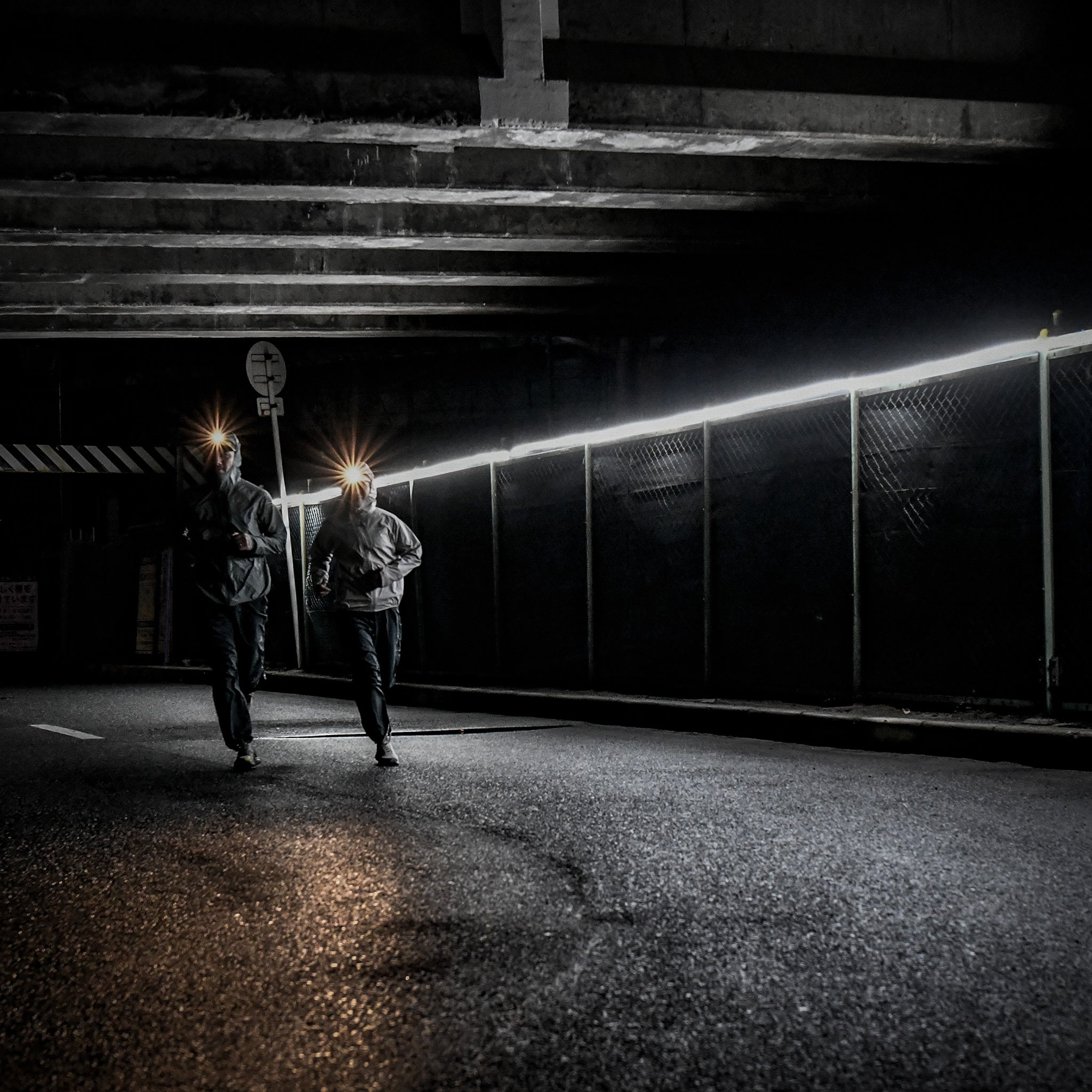
Yoshi: UP-SWING Rain Hoody and Rain Pants.
Nishi: We at milestome are finally releasing rainwear. Speaking of rainwear, isn't it a pretty high hurdle?
Yoshi: And the technical level too.
Nishi: Rainwear is expensive, you don't replace it often, and if it's not of good quality, it's useless as rainwear. When I started running in the mountains myself, I realized that there are many different types of rainwear. After testing various types with Yoshida, I learned and experienced the various advantages and disadvantages, and finally arrived at the point where it will be released soon.
Yoshi: It's finally here. It took over a year. The fabric was probably the hardest part.
Hagi: With so many different fabrics to choose from, it's a question of which to choose. The specifications are already available on the online site, so I'd like to hear more about that.
Yoshi: First of all, the fabric is "3-layer." It looks like one piece, but it's actually three layers. There's an outer and inner lining, and a waterproof, breathable film-like material called a membrane is sandwiched between them. You may also hear "2-layer" or "2.5-layer" often, but these refer to two layers without a lining.
Hagi: If it was two layers, it would stick to the skin, so the surface was processed to be 2.5 layers.
Yoshi: Without the lining, it's lighter, but I was worried it might be less durable and comfortable, so I started looking for a three-layer fabric. When you see something like "20D outer/7D lining," the higher the number, the thicker the thread, meaning the thicker the fabric. The thicker the fabric, the heavier it becomes. Currently, there's a trend toward ultralight, where lighter is better, so we initially chose a fabric with 7D outer and 7D lining. This is probably the thinnest fabric available in the industry at the moment, meaning it's the lightest. And the thinner the thread, the more expensive it is. I wanted to make the best possible product, so I made samples with premium fabrics.
Nishi: And then it was really cold. It was like I could feel the cold of the rain.
Yoshi: I was wondering why that is, but the membrane in the middle of the three layers can be broadly divided into three types: "nanofiber," "hydrophilic non-porous membrane," and "hydrophobic porous membrane." This is a bit of a geeky story, but is that okay?
Nishi: Let's dig deeper here. Weekly Milestone.com is shallow and broad (laughs).
Yoshi: The first thing I chose was "nanofiber."
Hagi: So ultimately you end up choosing a "hydrophilic non-porous membrane." I'm prepared for this to be a difficult question.
Yoshi: It's easy to explain, so let me start by explaining what a "hydrophobic porous membrane" is. It's hydrophobic, meaning it hates water. The film is also porous, with countless holes. The holes are so small that rain from outside doesn't seep in, but the steam from your body can pass through.
Hagi: Rain is water, but water vapor is a gas and is small in size, so it escapes.
Yoshi: That's how it works to make the membrane waterproof and breathable. Next, the "hydrophilic non-porous membrane" has no holes. It absorbs moisture, stores it in the film, and then evaporates to the outside.
Nishi: I understand the structure. So what are the advantages and disadvantages of a "hydrophobic porous membrane"? Simply put.
Yoshi: The advantage of "hydrophobic porous membrane" is that it is breathable and highly breathable. That's both a good and bad thing. The disadvantage is that it has many holes, so the fabric cannot be made thin due to its strength. However, the "nanofiber" that I will explain next has the best breathability. "Hydrophobic porous membrane" is more of a balanced type. "Nanofiber" has a sheet-like structure with fine threads woven together.
Hagi: It's fiber, so it's fiber.
Yoshi: Because there are lots of gaps, it's more breathable than breathable. The advantage is that it's very breathable. On the other hand, the disadvantage is that it has poor heat retention. It also has poor waterproofing and water resistance.
Nishi: What about using "nanofiber"?
Yoshi: It's Pertex Shield Air. In terms of manufacturers, it's Yama to Michi's rain jacket.
Pertex Shield Pro is a "hydrophobic porous membrane." Pertex Shield is a "hydrophilic non-porous membrane." Milestone's UP-SWING falls into this category.
Nishi: The structure of the "hydrophilic non-porous membrane" is the same, but the fabric is different.
Yoshi: The nanofiber sample was the one they said was "cold." We called in the factory staff and they tested it, and when they sprayed water on it with a hose, it didn't get wet because there was a film on it, but it was really cold.
Nishi: So what are the advantages and disadvantages of "hydrophilic non-porous membranes"?
Yoshi: It's warm, or rather, it has good heat retention. If you do extremely intense movements, it might get steamy. The advantage is that it can be made thinner, which means it's lighter.
Nishi: I haven't felt too stuffy though. I also did a waterproof test while wearing it and moving around. I did thorough field tests to make sure there were no leaks. I walked for two hours in the pouring rain and felt fine. I noticed that it was leaking from the top of the zipper on the chest pocket, so I modified the design to keep water out.
Yoshi: When it was actually finished, we both wore it to run in the Shinetsu region last year. It happened to be pouring rain. Some people around us got hypothermia, but as we ran, we kept saying to each other, "It's so warm," and we were able to withstand both the rain and the cold, so we were convinced that we had made the right choice by using this fabric.
Nishi: It was good that we could both feel it at the same time on the field. Shinetsu was really tough, but talking about work cheers me up (laughs). We were able to reach a common understanding there, and that's when we decided to go for it.
Yoshi: Production has finished, so we just have to wait for the items to arrive. I think it would be easier to understand the patterns and shapes by watching the video.
Nishi: A great feature is that it can be worn over a trail running backpack.
Hagi: There's a tuck in the back. It looks like it would be easy to swing your arms.
Yoshi: Although it's specifically designed for trail running, I'm also planning to actively use it for fastpacking. However, if you try to design it to be usable for everything from the start, it will end up being half-baked. So, we basically created something that we would most like to wear when running 100-mile trail runs or long races. Ultimately, I feel like it can be used for a variety of other activities as well.
Nishi: It's soft, stretchy, and flexible. When you run with the hood on, the rustling noise can be really stressful, but this one doesn't have that noise.
Yoshi: It stretches because we use a thread that shrinks and curls. It's 100% nylon, but it stretches. The fabric is made in Japan.
Nishi: It's made in Ishikawa Prefecture. I actually went to the factory and saw how the thread is made, and it really felt like we were making something together. I hope you'll also watch the video of the factory.
Yoshi: As I said in the explanatory video, the arms are three-dimensionally cut. The back of the hand is longer and has thumbholes so you can put your fingers out. When you don't put your fingers out, it closes to keep the rain out. That's a different shape from the Onion Hoodie.
Nishi: I also like that there's a wire in the brim of the hood.
Yoshi: The zippers on the bottom of the rain pants are long so you can put them on and take them off even with your shoes on. The waist can be adjusted with a single touch using elastic. I feel like the silhouette of the pants could be wider for mountain climbing, but if they're too wide they're difficult to run in.
Hagi: If it's lace, you wear shorts.
Yoshi: You can wear it over Natty Long or Daybreak Long Pants. Both the top and bottom can be packed away when not in use. I often put it in my backpack due to race regulations. What is the origin of the name of this product?
Nishi: In the jazz genre, there are bebop, fusion, and swing. This time, the word "upswing" comes from that. It means rising. Even on a rainy trail, wearing this "upswing" will lift your spirits.
Yoshi: We want to start 2025 with an upswing. As for the color names, they're not based on animals or birds.
Nishi: There are three colors: graphite black, sage green, and ice gray. I think they all look great.
Yoshi: Even the black is a special order color, so it's not completely black. It's a little greenish.
Hagi: It's completely different compared to the black Natty Long.
Yoshi: The bottom is only available in one color, graphite black, which matches with all three colors on top.
Nishi: 16,000 yen for a pair of pants, don't you think that's pretty impressive?
Hagi: It's rare to find a jacket that costs less than 30,000 yen including tax.
Yoshi: The total weight of the top and bottom is less than 300g (size M). It's quite light. There are five sizes available, from XS to XL.
Nishi: I'd love for everyone to try it out in the field. There are four videos this time.
The promotional video was shot by the director. Close-up footage of the factory where the thread is made, showing how it is made. The product description video features Yoshida-san and I talking together. And there's also a behind-the-scenes discussion with Sayapi and Oji, who helped with the promotional video. Of these four, the product description video is the one that has been viewed the most on YouTube so far.
Yoshi: As we write in the catalogue, we think this is the best way for us to do things. We make each one carefully, give the baby a proper name, and pour our heart and soul into it, so that it will grow big and strong. It takes time and effort, though.
Nishi: It's really great that we're allowed to work at our own pace, rather than having to rush to create something for an exhibition.
Hagi: So you're pushing it to the point where you're satisfied with it.
Yoshi: Product development has no deadline (laughs).
Nishi: That's why I think we can create something good, and I think our customers will be able to feel that when they wear it. I hope you will continue to support "Tell Me! Milestone" in 2025. Bye.
Nishi, Yoshi, Hagi: Goodbye, goodbye, goodbye.
This time, we learned about the 10th anniversary catalog and rainwear. At the start of a new year, it's fun to imagine what you'll be like in the next 10 years. Incidentally, if there were a 20th anniversary catalog, I couldn't help but fantasize about what 10 new people would be included. Milestone, which makes rainwear and has even started a real podcast program, is excited to see where it goes from here.
See you next month.
Text and composition: Ken Hagiwara
Share :
Episode 24: Tell Me! Milestone "What is your milestone?"
Episode 26: Tell me! Milestone "What to wear when competing"