
This project started this year. "Tell me! Milestone"

This is a series of articles in which brand founder Nishioka and mid-career hire Yoshida delve deeply into and introduce milestone products.
Who are you? Nice to meet you. My name is Ken Hagiwara and I'm working up a sweat with the two of you at "#WednesdayBudouzakaPractice". I look forward to your continued support.

From left: Mr. Yoshida, Mr. Nishioka, Mr. Hagiwara
Well, in this first article we will be digging deeper into headlamps.
A lamp, not a light?
Yoshida (hereinafter Y): Sorry if I'm wrong. I thought you said "headlamp" just now, not "headlight."
Nishioka (N): That's a good point. Yes, milestone is a headlamp manufacturer.
Y: Eh? Not Light?
N: As you know, our company (Fuji Lighting Co., Ltd.) is a fishing tackle manufacturer, and we have another brand called ZEXUS ( https://zexus.com/ ) that specializes in lights. When we launched milestone, we wanted to create a niche. ZEXUS uses white LEDs and is a "headlamp" that pursues brightness. It wouldn't be interesting to do the same thing, and other companies in the outdoor industry are also using white LEDs, so as a latecomer manufacturer, we thought that if we were to do something, it would be better to come up with something different. Because there was a feeling that "incandescent light is really good."
Y: First of all, why is it incandescent?
N: Originally, we had a history of making carbide lamps ( https://fujitoki.co.jp/company/) .

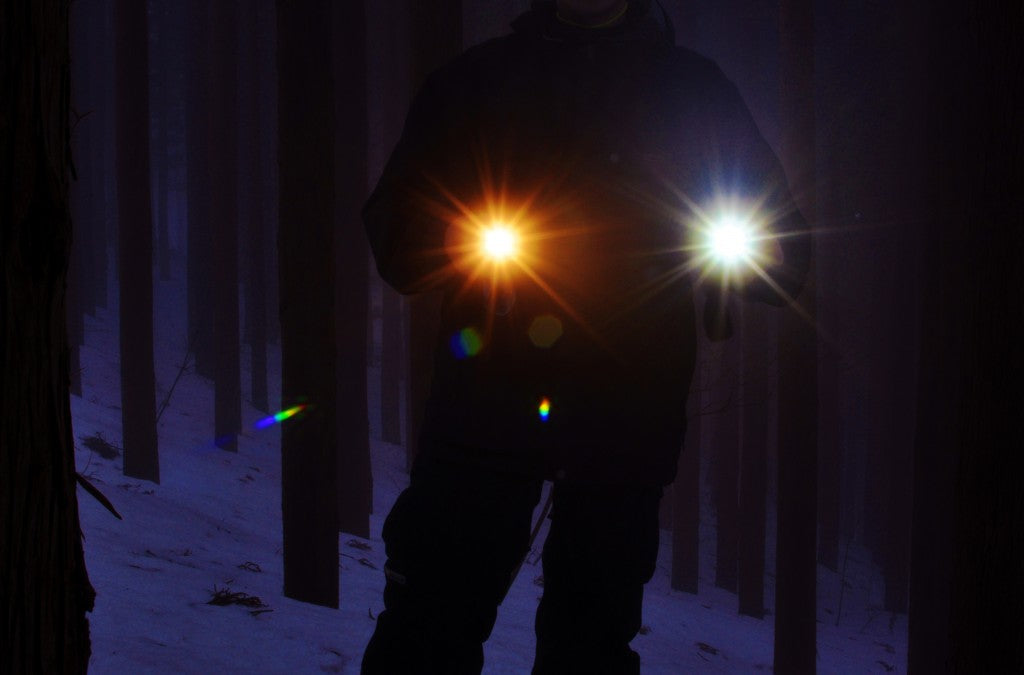
The soft orange light of the lamp is attractive. Lanterns and other things have a warm incandescent light, and food looks delicious. The only thing that's hard to tell is how well the meat is cooked (lol).
Y: (bitter smile)
N: In terms of dividing our company and differentiating ourselves from other companies, when people say "headlights," they think of "white," but I thought it would be better to call them "headlamps," so I drew a line in my mind. When people think of headlights, they tend to think of car lights.
Within the company we have two brands, one for lights and one for lamps, but that doesn't mean we tell other employees about it.
Y: You didn't say that? (laughs)
N: Actually, we field tested the warm white color until the very end, but I was extremely worried. ZEXUS has been around since 2008, and the market was white. When we started milestone in 2014, there was a moment when we ordered "warm white" instead of "cool white" from the factory. I wondered if it was really okay to go with warm white (laughs). But we were able to position milestone as "warm white," so I think it was a good move.

Y: I see. Warm white light is necessary in the mountains.
N: That's right. A veteran at a famous mountain and ski shop told me that the incandescent headlamp was very useful when it got foggy in the mountains. He was impressed that such an amazing person had used it in the field and proven it. The person I was with was using a white light, but said that it would have been dangerous without the incandescent light. That also gave me confidence.
Y: The inside of the tunnel is orange too, right? Does the warm white light give it a more three-dimensional look, or does it create clearer shadows?
N: Yes. When fog appears, it has excellent light transmission. It creates clear shadows and makes it easier to see where you are walking, which helps to avoid risk.
Disadvantages of incandescent light
N: Actually, there are some disadvantages. It's not something to hide, and it's better for people to know about it. The reason other companies don't do it is because the warm white light drains the battery a little faster. They want to use white to save energy and maintain brightness, but no one wants to do it because it uses up battery power. What's more, white light appears brighter to the human eye. There is data that shows that even if they are both 200 lumens, 200 lumens of white light and 200 lumens of warm white light appear 20% brighter to the naked eye. That's why everyone uses white light. But we wanted to differentiate ourselves even if it meant sacrificing that. Because we wanted to have something unique.
Y: But when the trail runners I run with regularly around me first buy a light, I get the feeling they only look at three numbers: lumens, duration, and price.
N: I think so. And lights are a low priority when it comes to gear. Shoes come first, then backpacks. Lights are last, and once you buy one, they don't break down easily. Shoes wear out, but lights don't.
Y: I've worn out and thrown away a lot of shoes, but the light I bought when I started mountaineering 10 years ago is still in good condition. However, as I've gained more experience in long races, I've started to worry about weight and fit. Small improvements in both areas have a gradual effect in the latter half of a race.
N: As expected of a 100-miler, you know what you're doing (laughs).
Y: Speaking of battery life, COROS has suddenly taken the watch world to a whole new level, but is there a way to make it last longer with a light?
N: There are various ways to do this. For example, if you take a photo inside a convenience store and it turns out dark, that's because the LED is flashing rapidly. To the eye it looks like it's always lit, but there's actually a moment when it goes out. We've incorporated this into our MS-i1 as well, because we want it to last as long as possible. In particular, when you dim*1 and reduce the brightness, it flashes rapidly. So fast that the human eye can't perceive it. That's one way to do it, and each company is coming up with various gimmicks to make their products last longer. It's really interesting.
*1 Dimming: Continuously adjustable brightness function
Y: That's deep.
N: Lights really are complex. There's a device called an integrating sphere*2 that measures light, and it can check duration, brightness, and color temperature. You can tell if a manufacturer is overstating their specs or if they're overestimating them. Conversely, you can see if they're being honest and understating them. I felt that with BLACK DIAMOND. They're designed to shine for eight hours. Both headlamps and lanterns are designed with the duration in mind, and how they'll achieve that duration. They crash perfectly at exactly eight hours. When you place emphasis on duration, you have to shine at a low altitude. Each manufacturer's skill is shown in how long they set the exposure time, at what brightness, and what they prioritize. I realized this when I introduced an integrating sphere to my home and was able to measure it.
*2 Integrating sphere: A sphere with a white diffuse reflecting surface coated with a high reflectivity on the inner wall. It measures the total luminous flux of a light source and light by multiple reflections within the sphere.


Y: I see.
N: Brightness and runtime are based on ANSI (American National Standards Institute) standards. To measure brightness, turn the light on with the battery fully charged, then wait 30 seconds before pressing the stopwatch. Then, when the battery reaches 10%, stop the stopwatch. This is the runtime. BLAK DIAMOND, PETZL, and LEDLENSER all publish this information in order to compete on a global scale. There are some geeky stories like that.
Y: I didn't know that.
N: I've only been here for two months so it's fine (laughs).
The birth of the flagship model "MS-F1: Trail Master"
N: If you're serious about making a headlamp for trail running, Doi-san*3 introduced me to him, and together we created the Trail Master from scratch. We made a list of Doi-san's requests and considered what we could and couldn't do. Doi-san said, "When you're running a 100-mile race, you don't want to worry or think about unnecessary things," so we aimed for the ultimate stress-free experience. First of all, it was about fit. Even though it flies and bounces around when you go fast, we wanted to make something that fits snugly, without any shaking or discomfort. Looking back, we think we could have used an existing wire system (laughs), but we thought we might as well make it in-house, and even created the mechanism for tightening the wire. We even obtained a patent, showing just how particular we were about it.

*3 Ryo Doi. As you all know, he is one of Japan's leading trail runners.
Y: It's a quick dial system.
N: That's right. Most headlights on the market today have just one switch, but we don't want people to forget how to press it multiple times, so we made the top a button to switch between warm white and white, and the side a lever that lets you feel the brightness change. We're pushing warm white as a milestone, but it won't be on all the time, so we made it so you can switch between warm white and white.
Regarding brightness, Doi requested that the brightness be maintained at the same level. The highest setting is 300 lumens for 5.5 hours. A typical person might be like, "Huh? 300 lumens only lasts 5.5 hours?" But even the mid-level setting of 160 lumens only lasts 9 hours. Nowadays, a headlamp wouldn't be viable without 200 lumens, right? That's how the world is. But while 95% of lights on the market today are designed to get dimmer over time, Doi wanted to maintain the brightness. He wanted to know how much battery he'd need for ultra-long distances, so he wanted to control it himself. That's why the runtime listed on the packaging is this: if you make it brighter, the time on the horizontal axis shortens, and if you make it darker, it lengthens. These two things are never separate.
Y: When I first saw it in a magazine, I thought, "Wow, a revolutionary headlamp has been released! But the price is revolutionary too!" (laughs) To be honest, I thought, "I can't afford to spend 17,500 yen (excluding tax) on a headlamp. I'd rather buy shoes instead," at first.

Source: RUN+TRAIL
N: I think so. So, since we'd made something so good, we wanted everyone to experience it, so we went on a road trip around the country with Doi to spread the word about how good it was. We thought that if the person who came up with the idea and the person who made it went around together and showed people how to use it in certain situations, they'd be convinced. And we actually got a good response.


Y: I think the Trailmaster is outstanding in its ease of use. Furthermore, when combined with the Koshihikari (Trailmaster + RUSH Light)*4, I think it's the ultimate. You can share the same battery, and even with the brightness set to the lowest setting, combining the two at your head and waist is bright enough except when going downhill.
*4 Trailmaster+RUSH Light has been discontinued. The current model is MS-i1+RUSH Light . "Koshihikari" is an unofficial nickname.

N: But it's been four and a half years since its release on August 5, 2018, and it's actually going to be discontinued in 2023. That's because the factory that supplied us with the batteries can no longer produce them, which is a real shame, and although it was our flagship model, we have to move on to the next step. We learned from the Trail Master that the burn time is short, so it would be better if it lasted longer. It was a little expensive, so we wanted to keep costs down as much as possible. And so we created the "MS-i1 Endurance Model." So, for those who have wanted or wanted to buy it until now, the 1000 lumens price of 11,800 yen (excluding tax) is probably a good thing in that sense.


Continued in Part 2
Part 1: Tell me! Milestone "milestone is a headlamp manufacturer." (Part 2)