

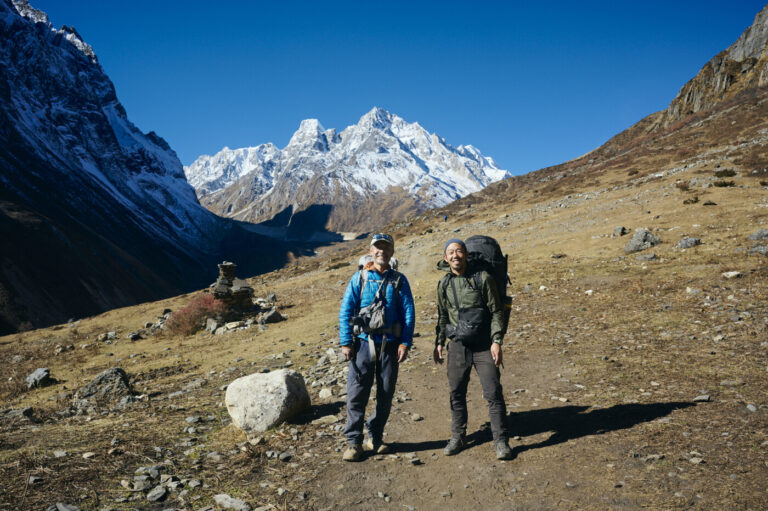
This series is a fictional podcast show in which writer Hagiwara (who runs #WednesdayBudouzakaRen together with Nishioka and Yoshida), the two people who created milestone items, listens to and delves into the stories of these two people.

(Video chat call begins)
Nishioka: Today, I'm video chatting with Dai Iizaka and Takahiro Nezu to prepare for the talk event "How to Walk the Great Himalayan Trail" that will be held at milestoneTERADACHO on October 25th. Thank you for joining us.

Iizaka (hereinafter, Ii) and Nezu (hereinafter, Ne): Thank you very much.
Nishi: Have you ever held a report session on the GHT (Great Himalayan Trail) project in Osaka in the past?
Meal: After my third trip in 2017, at the now-defunct Patagonia Esaka store. After that, I did it myself at Taninoki-sha Mountain Gear (Chuo-ku, Osaka) in 2021.
Nishi: It's been a while since you two came to Osaka together.
Ne: I kind of feel like I'm in an outside world (laughs) because I don't know many people in Kansai.
Nishi: The reason this happened is that Nezu-san came to Masashi-kun's talk event "Ururun Gravel Bike Packing in Thailand" in August and saw our venue and the atmosphere, so we thought maybe we could ask him to come and do it, and that's how we made the offer.

Ne: When I saw the venue, I thought I'd like to hold the presentation here. It would be a luxurious place and I thought it would be a luxurious time.
Nishi: We've only just started holding talk show events using milestoneTERADACHO. I thought Iizaka Dai's photos were amazing, so I never expected him to come along. After the talk show, the photos will be displayed in a photo exhibition for a month, so I'm looking forward to that as well.

Mei: I'm thinking of preparing around 10 pieces. It's a long journey across a wide mountain range, so these will only be a small part of it, but I'm really happy that people will be able to see them.
Yoshi: I think it will have a strong connection with the people who came to Masaru's event last month, "HIKE ICELAND - A journey with a line drawn on the map."

Nishi: I think the flow is incredibly beautiful.
Yoshi: I hope that reading this "Tell Me! Milestone" will inspire even one or two people to attend a talk event. I'd like to hear about your profiles and backgrounds, as well as your encounters and connections with mountains and nature.
・"Maybe this is it?"
Ne: I didn't do much mountain climbing when I was little. I was in the sports club in high school and university and played badminton. I lived in Shizuoka during university, and although people say that's not a good thing these days (laughs), I would make quick climbs of Mt. Fuji every year. I would start at 11pm from the Fujinomiya entrance and go three times with my club friends to see the sunrise. I just went for fun, like a student, and I wasn't interested in mountains. I just had the stamina (laughs).
About 20 years ago, when I was around 30, I started solo weekend mountain climbing. At the time, there were no other people around me who climbed mountains, so people would often ask me, "Why do you climb mountains?" I just brushed them off (laughs). Then, I started to wonder why I climbed mountains, and there came a time when I realized that rather than climbing, it was more that I really loved walking in nature and camping. Around that time, I read in a magazine or something that there was a long trail in the United States, so in 2012, at the age of 36, I set out to walk the PCT (Pacific Crest Trail: a long trail of about 4,200 km that runs along the west coast of the United States from the Mexican border to the Canadian border).
Before that, in 2008, Hikers Depot (a store specializing in ultralight hiking in Mitaka, Tokyo) opened, and I often went there to hear about ultralight hiking and long trails in the US. I had a feeling that this was the kind of mountain fun I wanted to do, so I went to the PCT, which was my first experience of long-distance hiking.
Back in 2012, it was completely unknown, and I thought it would be great if more people took up this type of activity, so I decided to become a writer focusing on long-distance hiking. I quit my job as a copywriter at an advertising agency and became a freelance outdoor writer.
I started going on hikes in the US a lot, and then in 2014, mountain guide Nemoto-san and I (Iizaka) Daiki and I started the GHT project and began hiking the Great Himalayan Trail. That's a rough outline of my background.
Nishi: I see. What did you think, Dai?
・"The mountains are crazy."
Ii: I was born in Tokyo and grew up playing baseball all my life, all the way up to university. Like Nezu, I was a sports-oriented kid, and was completely devoted to baseball, with no interest in mountains or photography. At Hosei University's Hachioji campus, I was surrounded by people like track and field athlete Dai Tamesue and others who had competed in the Olympics, and the baseball club also had many players with experience at Koshien, but I joined as an ordinary student. I was always thinking about how I could achieve results within that environment.
Thinking back, I was living in Takao and in an environment surrounded by mountains, and I would run in the mountains as part of my training routine, but at the time I wasn't aware that it was trail running or that climbing mountains was a part of my lifestyle.
I did start job hunting, but I wanted to find a job that would allow me to contribute to society and find meaning in it, and since I had only played baseball up until then, I decided to go on a trip to a place with values far removed from where I was born and raised. That's when I discovered a camera, and I began to want to express myself through photography.
I was backpacking around Asia for just under a year, and although I hadn't intended to do so, I ended up trekking in Nepal. I was so incredibly moved by it. Not just the scale of the mountains, but of course the people who live there too. Originally, I was traveling to take portraits and capture people's gazes, rather than the outdoors or mountains, but when I encountered the mountains, I thought, "Mountains are amazing!" The mountains are invigorating, and I was fascinated by both the people who live there. Everything else was great except Nepal, though.
When I returned, I wanted to cherish my country more, so I decided to see it properly one more time and cycled across Japan. It was the heyday of messengers, so I started out as a messenger, building up my stamina and knowledge of maintenance, then at the age of 23, I cycled from Hokkaido to Okinawa. I think this was the first time I used a tent and sleeping bag for the outdoors. During that time, I also went to Yakushima and climbed mountains, which sparked my interest.
I wanted to get more involved in the outdoors, so I got a job at Patagonia's Shibuya store and started doing activities with the people I met there.I had more and more opportunities to climb mountains, and I also started taking photos of them.
In my late twenties, I decided that I wanted to pursue photography as a career, so I worked in advertising and fashion for celebrities for four years, gaining experience at a studio in Tokyo, and hiking in between. In my thirties, I became independent and once again went to the Himalayas, traveling to places I could go on my own, such as the Everest Trail and the Annapurna area. While taking photos and selling them, I gradually began to receive more outdoor work.
I was in my early 30s when I discovered GHT and met its leader, Nemoto, at a time when I wanted to travel and take photographs to places beyond my own reach where the lifestyle remained untouched and undeveloped.
・The beginning of GHT

N: So that's when GHT started to take off. So, when you met Dai, you were 37 or 38?
Ne: I think I was 38 years old.
Mei: It was the winter of 2013-2014.
Nishi: So that means it's been exactly 10 years. Our milestone is also celebrating its 10th anniversary. We've been together since 2014. Are you and Nezu-san the same age?
Ne: I was born early in the year, so I'm in the generation of Ishikawa Hiroki and Kuwahara Kei.
Nishi: I'm sorry, you're my senior (laughs).
Mei: We're pretty much the same generation.
Nishi: The person you mentioned, Mr. Nemoto, is that the founder of GHT?
Nemoto: He was the initiator. He originally worked as a mountain guide, and was a pretty serious climber who had climbed unclimbed peaks in the Himalayas and big walls in Yosemite. He was good friends with Tsuchiya from Hikers Depot, and we connected through the store. Nemoto is a total climber, so he's been to Nepal quite a bit and was interested in the local life and culture. When he learned about the Great Himalayan Trail, he felt it was worth walking and had a strong desire to spread the word about it to people in Japan, but he's not a long-trail climber, and he's not the type to spread the word about it. I had walked the PCT and was working as a writer, so he first asked me, "Do you want to walk the GHT with me, Nezu?"
Nishi: That was 2014?
Ne: Around the end of 2013, I guess. But rather than giving an immediate answer, I said I would think about it for a bit. I had never been to Nepal, and I'd only been to America, so I wasn't interested at the time.
After coming back from America, I thought maybe I didn't need to do thru-hikes (walking from the starting point to the finish line in one go) anymore. It's not a question of whether it's good or bad, it's a matter of likes and dislikes, but in the end it's just a game of aiming for the finish line. Personally, what I like about long-distance hiking is being swept away by the situation and enjoying the journey along the way. I felt that this was its charm, different from mountain climbing.
If we wanted to thru-hike the GHT, I think it would be doable for Nemoto, myself, and Daiki. As long as we had the time and money. It's said that it usually takes five or six months, but Nemoto had no intention of doing that at all, and we were planning to do it once a year for one to two months.
Nishi: I see.
Ne: I also thought that it would be a much more fulfilling trip and that I would enjoy long distance hiking, so I did some research and found that it seemed to have a different charm to America, and I thought it would be even better if I could experience that and spread the word to people in Japan, so I said, "Let's do it." Dai joined us after that, but what event was it again?

Mei: It was an event where about four speakers with different personalities who all love the Himalayas were speaking, and Nemoto mentioned that he was passionate about the Great Himalayan Trail. I was surprised to learn that there were people like him and that such a journey existed, and thought it would be really fun. I had just become independent and wanted to improve my mountain skills, and I'm a tough mountain climber, and Nezu-san has a lot of experience, so I felt that he could lead me in a way. There were other people who wanted to do it, but it's quite difficult to put in that much energy and time, photographing both the mountains and the people. But I thought I had the stamina and could do it, so I asked if I could join, and I "got in the way" (laughs). At first, I thought it would be over in about five years, and I never expected it to become such an epic, life-changing journey (laughs).
Nishi: It's been 10 years already.
Mei: I didn't want to do what someone else was doing, and I didn't want to compete with others to get faster, so I thought it was meaningful to draw our own line. In that sense, I'm still really glad that I did it. The further I go, the more I understand the differences between sections and the changes of the times, and over time I gain a deeper understanding, and I change as well, so in that sense, it's growing in a different way from the early stages, and I feel like it's becoming a good project.
Nemoto has participated in adventure races with various people, including Kei Taniguchi (a leading female mountaineer in Japan), so we were three completely different people with different backgrounds who came together.

Nishi: When did you leave, Nemoto-san?
Ne: We're fading out, but it's not like we've had a falling out or anything. I just haven't talked about it openly because I don't think it's worth saying. It's not like we're hiding it at all. The three of us went together five times since 2014, but due to personal reasons, including Nemoto's lifestyle, he stopped going after the end of COVID-19, and it's just me and Daikimi who continue.
Nishi: We don't know if new members will join again.
Ne: I don't think so (laughs).
Yoshi: First of all, was the name GHT given by the local people?

Ne: It was originally launched in 2011 by the Nepalese government and a British international cooperation organization. Nepal has a problem of overuse, with tourists only visiting famous places like Everest, Annapurna, and Langtang. As a tourism-based country, they wanted to attract tourists to other areas as well, so they established a trail called the GHT that crosses the Himalayas from east to west Nepal. When I say established, I don't mean that they built and maintained a new road like the trails in America and Japan. They simply arbitrarily designated an existing road as the GHT. That's why there are no signposts at all.
Yoshi: There isn't (laughs)
Ne: So, to be honest, I don't even know where GHT is (laughs), but there is a rough map. It's a common thing in Nepal, but the Nepalese government has suddenly pulled out and isn't doing anything. As for outreach activities since the launch, there is a guidebook written by a British man named Robin Borstead, and he has basically been the main person continuing to update it. We met Robin in 2014 when he happened to be staying in Kathmandu.
Mei: If there's anyone in Asia who's willing to do it, we'll support them, so let's exchange and share information. Before 2011, Nepal was in a period of political and religious instability, with bandits and differing ideologies, making it difficult for both Nepalese and foreigners to travel to other areas. Things calmed down and people were able to visit each area, which is why GHT was created. It's a multi-ethnic country, so I think this trail is important for Nepal in the sense that it promotes mutual understanding and connects parts that you can't understand unless you go there, and I think it would be interesting if we could convey the differences and good points of each culture.

Ne: The main theme is GHT, but we're not just experiencing the trail; we're also experiencing the charm of the Himalayas and Nepal, including the food and culture, so I'd be happy if people could learn a little about that.
Ii: I think many people have never been there, but I think it will betray in a good way the image they already have of the Himalayas and Nepal. Because you're traveling among people who live there, you might think it's far away, but in fact, it might make it feel closer to you as if it's connected to the mountains behind your house. I used to live in Tokyo, but I've now moved to Iwate and am raising my children there. I'd like to talk about why I'm living so close to the mountains, and what I'm thinking now, including that change.
I thought we might be able to talk about things like the rural woodlands of Fukuoka that Nezu walks through, and the synchronicity he feels between the Himalayas and Iwate.
Hagi: What parts of the project will we be able to hear about at the talk show?
Ii: I've been there seven times in the past 10 years, so if I were to tell you about all the highlights so far, it would take three or four days (laughs). I'm currently deciding how much to include about that and how much to include about my latest trip.
Nishi: Understood. I look forward to seeing you on the day!
Ne/Mei: Thank you very much!
(Video chat ends)
Nishi: Hello everyone. "Tell Me! Milestone" is broadcast on the 25th of every month, and was recorded today, October 9th. This episode is a special edition, so we interviewed the two of you about what the Great Himalayan Trail is, as we wanted to know and share it with others.
Yoshi: From your stories about club activities, we learned how your involvement with mountains began and how you discovered GHT. We also learned about what each of you values and how you have become as people.
Nishi: Nezu-san is a writer and Dai-san is a photographer. Roughly speaking, Nezu-san is a hiker and Dai-san is a traveler. The characters of the two characters are reflected in the conversation, with Dai-san being serious and Nezu-san being airy. I felt that it was a good balance.
Hagi: Photography is a visual medium, and writing is a way of putting things into words, so I thought it would be the other way around.

Yoshi: Your character and job were the opposite of what I thought (laughs). You said that rather than reaching the goal, you focused on enjoying the process. I've always dreamed of climbing the Himalayas, but even if I don't go, I think my connection to mountains and my worldview will expand, so I'm looking forward to the day.
Nishi: This book, "Going the Path of Life," is amazing. It's written by a writer and photographer. Not only the photos, but also the layout and text.
Yoshi: The talk show has a capacity of 40 people and admission is 1,500 yen. The photo exhibition will run for about a month from October 26th. We hope that even those who have other commitments and can't make it to the talk show will come and see it. Enter here

Hagi: The screen has gotten bigger since the last talk show, so I'm looking forward to seeing the large-scale photos of the Himalayas on a big screen.
Nishi: Is there anything else you'd like to announce?
Yoshi: In November, we will be participating in the OMM (Original Mountain Marathon) as Team Milestone. Of course, we will also be running. If you say, "Oshi! I'm listening to Mai," we will give you a sticker as a gift.

Nishi: There are only two months left this year. Let's run through it.
Yoshi: Finish strong. Don't say "I'm quitting" in the middle of the race like some people do.
Hagi: That's Shinetsu... (laughs)
Nishi: Well, that's all for today! So please look forward to it!
Nishi, Yoshi, Hagi: Goodbye, goodbye, goodbye.
This time, instead of introducing products, we brought you a pre-event interview. Whether you are a runner or someone who regularly engages in mountain activities or activities, or if you live close to the mountains and nature, or have an interest in the Himalayas or Asian culture, we are sure you will enjoy the content.
As I was checking out @ght_project 's Instagram to prepare further, my mind was transported to the Himalayas, transcending time and space. I found myself searching for a reason to go on a trip. Well, I'll continue this story over the weekend.
Text and composition: Ken Hagiwara
Share :
Episode 21: Tell me! Milestone "The joy of stacking"
Episode 23: Tell Me! Milestone: "What's the new 'S'?"