
This series is a fictional podcast in which writer Hagiwara (who met them at #WednesdayBudozakaTraining) asks the three (Nishioka, Yoshida, and Haruka) about everything related to milestone and delves deeper into the topic.

The late summer heat seems to be here to stay. So, what's new this month?
・New flagship headlamp model
Nishioka (hereafter, Nishi): This month, we're introducing two new items!
Yoshida (hereafter, Yoshi): First, the new headlamp.
Omori (hereafter, Haruka): Its official name is "MS-i2 'Endurance Pro'."

Hagiwara (hereafter, Hagi): Pro?!
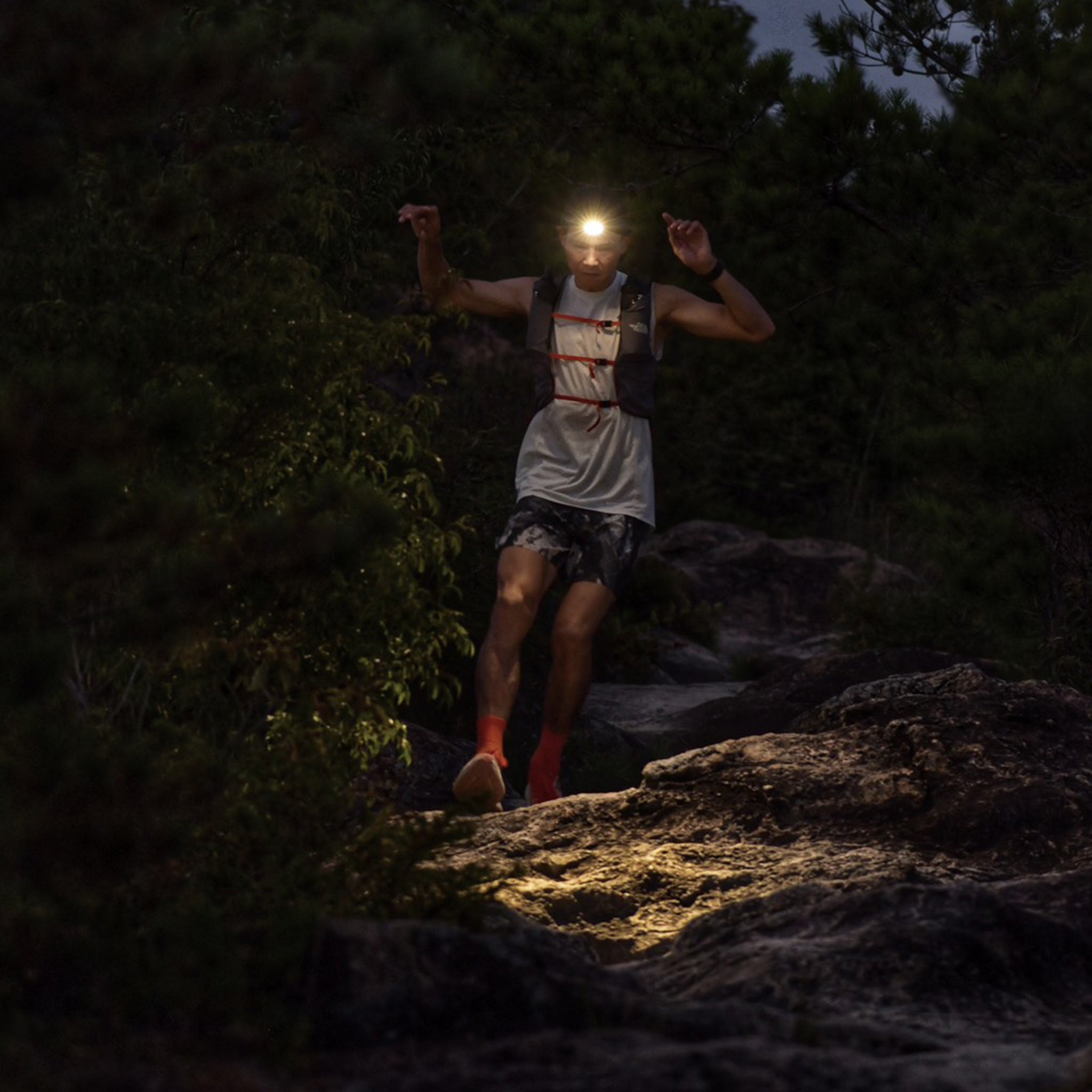
Nishi: Yes. What makes it "Pro" is that it's an upgraded version of the "MS-i1 'Endurance Model'," which has become quite common in long races. The first upgrade is brightness. It's now 1,100 lumens.
Haruka: The MS-i1 was 1,000 lumens.
Nishi: Whereas the MS-i1 used two incandescent and two white lights to create natural light, this time all four lights are natural-light-like (natural warm color).
Hagi: Why is that?
 Nishi: The change makes the LEDs themselves brighter with higher luminosity, and it also increases irradiation efficiency to extend battery life.
Yoshi: It's still effective in foggy conditions, just as before.
Nishi: Next, the battery capacity has increased. The previous battery, "MS-LB3," was 3,400mAh, while the "MS-LB4" is now 5,000mAh.
Haruka: At its brightest, 1,100 lumens, it lasts an astonishing 10 hours. On the lowest setting (100 lumens), it lasts 76 hours.

Yoshi: By the way, with the MS-i1, it was 7.5 hours at its brightest and 53 hours at its lowest (65 lumens).
Hagi: The MS-i1 automatically dims, is the MS-i2 the same?
Nishi: It's the same design. It gradually dims over two minutes to avoid unnecessary illumination.
Haruka: Regarding brightness and battery life, the MS-i1's middle setting of 260 lumens (11 hours) has become 350 lumens (19 hours) on the MS-i2. The high setting of 480 lumens (8 hours) has become 730 lumens (12 hours).
 Nishi: And the best part about the battery this time is that the conventional MS-LB3 battery can also be used with the MS-i2. By using an aluminum cap called a "spacer," it fits perfectly. I think this is the biggest point.
 Yoshi: When you participate in trail running races, you need a spare battery for your headlamp as essential equipment, right? Those who used the MS-i1 should have two, including a spare, so using them means you don't have to buy another MS-LB4 as a spare. It's a user-friendly design.
Hagi: That's very helpful.
Yoshi: In terms of battery weight, the MS-LB3 was 50g, while the MS-LB4 is 79g, making it about 1.6 times heavier.
Nishi: While longer battery life is definitely an advantage, the increased weight becomes a disadvantage in long trail running races. So, we changed the belt shape to reduce swaying by improving the fit. The back part is not a belt but a bungee cord that can be tightened instantly, allowing it to fit snugly on the head.
Haruka: This is called the "Quick Adjust Band."
 Nishi: Actually, we also changed the material of the band. If you tighten it from behind with the same band as the MS-i1, it stretches quite a bit. The logo stretches too.
Haruka: It becomes like "Mile-stone."
Hagi: I see (laughs). So it's made of a non-stretchy material. The battery base at the back is also larger.
Nishi: To provide more stability. We also added cushioning material to the forehead area so it doesn't hurt even when tightened.
 Yoshi: The MS-i1 has been a long-selling item, but we always want our flagship model to be better, brighter, and last longer. We were hoping for technological innovations to make batteries lighter, but there hasn't been much change there yet. It's not just us; a 5,000mAh battery has the same weight worldwide. If we put a 5,000mAh battery in the MS-i1 form, the back would become heavy, so it took us four or five years to commercialize it because we struggled to balance that and went through a lot of trial and error. The reason we use a cord instead of a band is also to reduce weight as much as possible.
Nishi: 5,000mAh is enough to function as a mobile battery, and it should be able to charge a smartphone properly.
 Haruka: The indicator light during charging changes from red to green when charging is complete, as before, but it turns blue during power supply. It turns off when the capacity runs out.
Nishi: It's been four years since the MS-i1 was released, so it's finally time. We're really grateful that the MS-i1 was accepted more than we expected.
Yoshi: B-T-W, the MS-i1 will continue to be sold.
Haruka: However, if you are reading this column on August 25th, the release date, and you don't have an MS-i1 yet, buy it now!
Hagi: Meaning?
Haruka: The price will go up from September 1st. It will go from 12,980 yen (tax included) to 15,400 yen (tax included).
Nishi: The price of lithium batteries is skyrocketing right now. The weak yen and rising labor costs are also factors, but it's a difficult decision. We have no choice but to raise the prices of the MS-i1, MS-LB3, and other models equipped with lithium batteries.
Nishi: The MS-i2 is priced at 19,800 yen (tax included), as originally planned.
Hagi: No change from the catalog price, then. Just to confirm, is that price inclusive of the battery?
Nishi: It is included.
Hagi: As an MS-i1 user, I have a request. You sell the RUSH Light 2.0 as a set, but could it be sold separately? So that one could be used as a "Koshihikari" (headlamp for waist) in conjunction with the MS-i2.
Yoshi: There's a very sad story behind why we don't sell it separately. When the RUSH Light 1.0 was out, we did sell it separately. Then, even though it's a collaborative item between PAAGOWORKS and milestone, we kept seeing people wearing lights from other manufacturers.
Nishi: At the time, PAAGOWORKS sold the individual units, and we sold it as a set with the headlamp. Because of that past, it made us sad, so we went and asked them if we could sell the RUSH Light 2.0 as a complete set only through us, and they agreed.
Hagi: I see. In that case, I'd love to see an MS-i2 version of the RUSH Light.
Haruka: We are diligently working on it!
Yoshi: You could use the MS-i1 for your head as before, and the MS-i2 as a "Koshihikari" (waist lamp). Or vice versa.
Haruka: We hope to support those who aim for greater heights, those who challenge themselves with longer races and long traverses.
Nishi: It's made to pro specifications. It seems that Masatoshi Obara will be wearing it when he runs the upcoming UTMB (Ultra-Trail du Mont-Blanc). Also, I went with Mr. Doi to shoot a promotional video.
 Nishi: The video turned out to be very dynamic, and it truly showcases Mr. Doi's skills. This will be released soon.
 Haruka: I also vividly remember Yuya Kawasaki winning the Kaga Spa Trail 2026 while wearing this.
Nishi: It goes on sale on Saturday, August 29th. Please check it out at a store near you. I guess that's all for this week.
Haruka: Wait a minute! We also have new apparel items!
・Cloud's siblings
Yoshi: Hello, I'm Yoshida, in charge of apparel. The Cloud Half-Zip is finished.
 Hagi: It's the Cloud Hoody without a hood, its younger sibling, so to speak.
Yoshi: I've always wanted to make this. When I first made the Cloud Hoody, I repeatedly tested it by wearing it directly on my skin.
Hagi: I remember hearing about it in Episode 12: "Shaping Clouds". You told me about active insulation, which keeps you warm while you move, and the origin of the name "Cloud."
Yoshi: From then on, I wanted to create something that could be worn as much as possible, so I pushed for a half-zip.
Hagi: What do you mean by "worn as much as possible"?
Yoshi: It means you can keep wearing it and keep moving without taking it off or putting it on. I think I talked about it in a previous episode, but the Polartec Alpha Direct material used for Cloud comes in three thicknesses: "60," "90," and "120." Honestly, I thought "120" was too thick for continuous movement. The Cloud Hoody uses "90" thickness. Mr. Nishioka said that because he wanted to be able to take it off and put it on, there would be more demand for a full zip. So, at the very least, we made it a double zip so it could be opened from the bottom as well.
 Nishi: I was opposed to a full-zip because it would make it heavier. A half-zip is fine for active use, but I thought this item could also be worn as everyday wear, so I ultimately went with a full-zip.
Yoshi: Mr. Nishioka also wanted to add pockets. I opposed that at first too, but he said it would be more convenient. He envisioned something like a lighter version of a sweat hoodie. In the end, we released it as such.
Nishi: We mapped grid fabric, and added a watch window and thumbholes.
 Yoshi: Polartec Alpha is a very popular material, and many outdoor brands use it, but I think we ultimately achieved originality.
Nishi: I think the Cloud Hoody gained recognition, which led to this next edgy item.
Yoshi: It's great when it's cold enough to snow, but personally, I sometimes find it a bit too warm otherwise. So, next, I wanted to make something truly wearable with the "60" thickness.
Haruka: It's more like a base layer than insulation, isn't it?
Yoshi: I want people to wear this directly on their skin. Mr. Nishioka said he wouldn't wear it on bare skin, but when I climbed Mt. Hakusan in May this year, I was able to wear just this one piece continuously from the trailhead, where it was about 15 degrees Celsius, to the summit, where a lot of snow remained.
Nishi: After testing it there and confirming it was good, I thought, "This will work."
 Yoshi: There are some half-zip items that look very much like innerwear, right? With a narrow body, like something you'd wear under ski gear. To avoid that, we've given it a relaxed neckline and kept the collar low so it's not uncomfortable. The zipper is also long enough to open down to the solar plexus for ventilation, which is a fairly detailed consideration. It's a younger sibling that can be used in a different way than its older brother, the Cloud Hoody.
Hagi: Both the shape and functionality seem very practical, and it looks like something you could wear as soon as the temperature drops a bit.
Nishi: The price, compared to the hoody's 23,100 yen (tax included), is now 16,500 yen (tax included), which I think is quite reasonable.
Yoshi: There's one thing that concerns me. We can only make this once a year. The fabric color is custom-ordered, and it's produced in collaboration with Polartec, so it takes a lot of time. But, it's a "milestone commonality" that for new items, we don't produce a huge quantity at first, but rather observe how it's received. However, with this functionality and a reasonable price, most of them go to specialty stores, and we don't have much stock left. That's what really worries me (laughs). This column will be distributed on the 25th, and it will be released from the beginning of September, so if possible, I hope you'll put it in your cart right away (laughs).
Yoshi: The Fast Tail Shorts, released in June, sold out quickly as expected and were just restocked the other day. We can increase production for those since they're domestically made, but if the Cloud siblings run out, they won't be available for another year.
Haruka: It comes in two colors: charcoal and maroon.
 Hagi: Both are good colors, so it's hard to decide. Does the charcoal have just a hint of green, not just plain gray?
 Nishi: It does. I like it (laughs).
Haruka: The maroon is cute, like a poodle.
 Hagi: It matches the fluffy feel. The collar height is also exquisite. The diagonal zipper, characteristic of milestone, has a different angle than other previous items, doesn't it?
Yoshi: The raglan sleeves have a seam, so we couldn't move it further outward than that. We adjusted it many times.
Haruka: It's hard for women to wear it as a single layer, so I recommend wearing a T-shirt underneath.
Yoshi: If it's windy, wearing a windshell over it will keep you warm.
Haruka: It seems good for OMM JAPAN in November, and for winter trail races like Ishibutai 100 and KYOTO GREAT ROUND.
Yoshi: I think it's really good.
Hagi: You just need to be careful when bushwhacking. It would be a pain to get caught on branches.
Yoshi: As insulation on the UTMB mandatory equipment list, it's too light and doesn't meet the standard of 180g or more. The Cloud Hoody is fine, though.
Hagi: That's for Mont Blanc, right?
Yoshi: For other races, it's fine even for Mt. FUJI 100. It's made for activity, so the longer back hem is designed with carrying a pack in mind, and that follows the hoody's design.
Haruka: It was a big help on the watershed trail last month, wasn't it?
Yoshi: Although you wouldn't use it during the day in midsummer, when I went to bed at night, I wore the Cloud directly on my skin, and then put on my sweat-soaked clothes from the day over it. The evaporative cooling meant they were completely dry when I woke up in the morning.
Haruka: I brought the Cloud Half-Zip for cold weather at night, and when I put my wet clothes over it, they dried, so I was able to wear them the next day without feeling cold.
Hagi: A warm air layer forms between your body and the wet clothing, which is probably effective.
Haruka: I can't wait for the cold weather.
Nishi: Well then, that's all for this month. Goodbye.
Yoshi: Goodbye.
Haruka & Hagi: Goodbye.
This time, we learned about the newly released top-of-the-line headlamp and the Cloud's sibling item, which will be useful in the coming season. Both sound like updated versions of previous items, but in reality, they were revolutionary products that changed the quality of activities and how we move. We're looking forward to figuring out how to wear and use them.
This summer, instead of climbing, I spent my time walking along valley bottoms. It was a fishing trip, but for a beginner like me, simply casting a line doesn't guarantee a catch. I repeatedly hooked branches and had to re-tie lost flies. However, that was precisely the precious time. When it comes to long-distance trekking, you tend to aim for the summit, worry about arrival times at campsites, and only take breaks for replenishment and photos before moving on. Sitting on a rock and savoring the present view. The feel of the rock, the reflection on the water's surface, and the sound of the splashing water. It was a rich way of spending time that I discovered by starting a new activity.
Just to be clear, it's not sour grapes because I didn't catch anything.
Well then, until next time. I hope it will be cooler by next month.
Text and composition by Ken Hagiwara
Share :
Vol. 43: Tell Us! Milestones - "What You Learn from Running"
No. 45: Tell me! Milestone "Which one should I choose?"