

This series is a project in which Hagiwara (who runs with him in #WednesdayBudouzakaRen) listens to the stories of two people who have created milestone items (founder Nishioka) and used them (mid-career hire Yoshida) and delves into them.
・This is my hometown
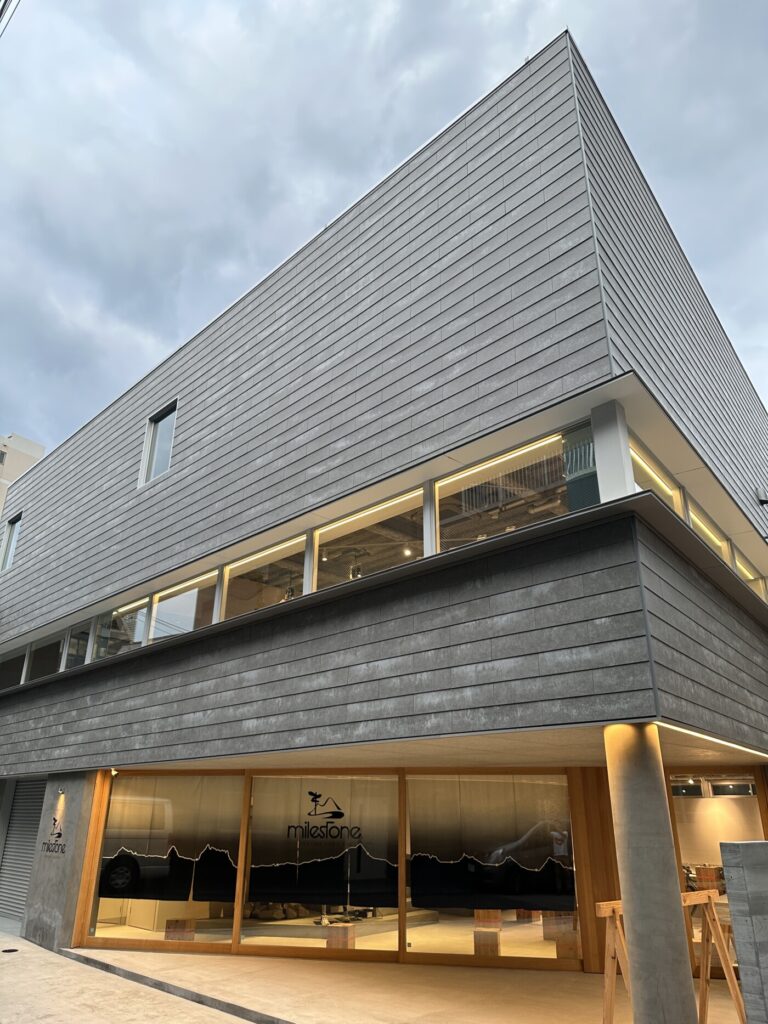
Hagiwara (hereinafter H): This time, I'd like to talk not about items, but about the new store that is finally opening, including what prompted it to open and what kind of place it is.
Nishioka (N): To trace it back to its origins, when Doi and I were traveling around the country on a road trip, we were drinking in a room on a ferry heading to Kyushu, and we were talking about how it would be nice if milestone had its own venue and could do something. I think it was around March 2021.
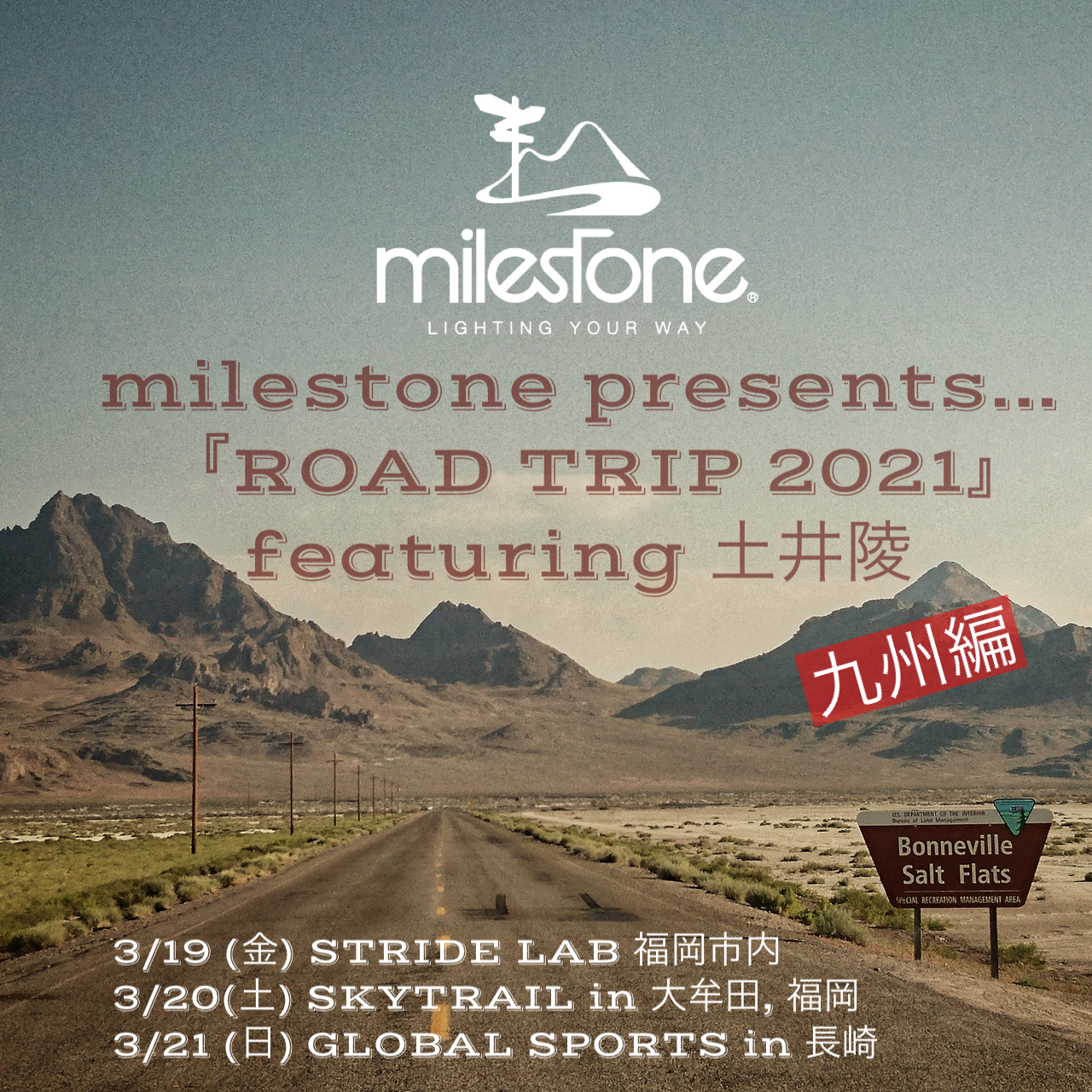

Yoshida (hereinafter Y): The idea of a "road trip" to test out the Trail Master came up in the first headlamp episode.


N: At the time, we were just talking about how we might do something like that someday. Then, by chance, the land across from our company became vacant. A surveyor came and measured the land, so I asked him, "What's going on?" The landowner replied, "My son is in Tokyo, and I'm over 80 years old, so I'm thinking of selling this land." I said, "What?! Come on, man, let me tell you what it has to say." It had already been decided that he was going to sell it to a bank. This place where our company is located is my parents' home, and I've been playing catch with the man across the street since I was little. He used to run a sandal shop. There are a lot of them around here. They're called "hep shops."
Y: Hep? I've never heard of it. Well, how about the Ferris wheel in Umeda?
N: It's irrelevant (laughs)
N: And then he said, "Hey, I'm interested in that too," even though he hadn't decided anything yet (laughs).
Y: That's amazing (laughs).
N: First, I decided to talk to my dad about it. I told him that I thought it would be great if we could do something, and that I wanted to do it. My dad said, "Okay, let's go and hear what they have to say." The landowner then said, "Well, it would be better to give it to someone in the community," and he completely changed the story, and things moved along smoothly, until he said, "We'll give it to you, Mr. Nishioka." It was incredible timing.

Y: That's true.
N: I just so happened to be there, and the old man was there, so I called out to him. I thought it was really lucky. I'd been wanting to have my own place in the future, and I thought this couldn't have come at a better time. It was a little big, but we had no choice but to go for it, so they cleared the lot. If it was a vacant building, there would be limited options, and we'd have to decide how to use it, but because we were starting from scratch, we could do anything and everything.
H: The possibilities are endless (laughs).
N: I spoke to designer K, who I mentioned in the last story about socks. He's an indispensable part of milestone, from the brand design and catalogs to the logo, belts, headlamp coloring, and T-shirt design. He's like a partner to me, and he's been with me since the beginning.

N: Fortunately, K-kun not only does graphics, but he also does building interiors, perspective drawings, and design, so we had no choice but to ask him. He understands it better than anyone. And he has an outstanding sense. So, when we were thinking about how to build it from scratch, my dad said, "The door should face due south." I think it was probably a feng shui idea, but that was the guideline we decided on, so we said, "That's it!" and moved forward.
N: By setting the building back from the street, we were able to create a spacious space overall. The doors can be opened fully, and the counter juts out from the inside, solidifying the concept of creating a borderless space that can be used both inside and outside.

N: And, first of all, because we are a headlamp manufacturer, our goal was to create a "darkroom" where people could experience the brightness of our headlamps. We wanted people to see our distinctive incandescent-colored headlamps, so we used a smoke machine to create mist so people could experience the difference between white and incandescent color. We also wanted to create a space where people could have a simulated experience of being in the mountains.
H: Even in the fog (surprising). You can't see it even with your headlamp on under fluorescent lights.
N: There happened to be a specialty store nearby that specializes in artificial flower planting, so I went in on a whim and explained the purpose and concept to them, and they said, "We'll definitely do it, we'll even walk there." They also knew about Doi and the "BAMBI100 (a 100-mile run event held on Mt. Ikoma and the Yada Hills)," so we immediately decided to ask them to do it (laughs). Above all, I wanted to do something that was close to the community, so I got the neighbors involved.

Y: That's why the store is named Teradacho.

N: Abeno Harukas is nearby, so we could have called it Milestone Abeno, Milestone Osaka, or any other name we wanted, but we decided on "Teradacho." I don't think people in Tokyo know about this downtown area, and it's not that well known in Osaka either. But by using that as a name, we hope to help people remember it at least a little. This is our hometown, after all. With that in mind, we decided on the name "milestone TERADACHO."
Deviation from theory
Y: This time, I was hoping to have Nishioka do 95% of the talking, because I wanted to show him how much I love him (laughs).
Actually, I had been participating in important store meetings even before joining the company. When I joined in November last year, the site was still vacant. They only had the concept and the outline of the blueprints, and it felt like they hadn't really decided what to do inside each floor.
N: That's right.
Y: We develop the products together, so I really think of them as my own child (creation) and pay a lot of attention to the smallest details. But when it comes to the store, Nishioka-san has a lot of love for it (laughs). He even tells me stories about his first girlfriend.
Y: For about a month or two after I joined the company, I was always called in and asked, "Can I talk to you for a second?" I wondered what it was, and when I went over, it turned out that the store was under construction and they were asking me every day, "Is this a good place? The concrete is being poured in. Isn't this amazing? (In a good way)." All I could say was, "You're right" (laughs).

N: I've also learned a lot of technical terms for buildings. I talk to the site supervisor every day and find out what the process and arrangements are today, because I'm on site more often than the site supervisor (laughs).
Y: I have experience in retail sales, so when it came to opening an actual store, I told them what the theory behind it would be. For example, the design of the fixtures that hold the products is cool, but there isn't enough space to display the products. It's hard to sell if you can't store the stock. I've said to them several times that I'm sorry but I'd like to have a say in the sales aspect.
There are many cases where the sales theory is ignored and the concept wins out. Normally, when you open a street-level store, if you think about sales, the first floor is always the sales floor.
You wouldn't go into a convenience store where they say, "The first floor is the office, please go up to the second floor" (laughs).
H: I've never seen anything like that.
Y: That's why I was surprised at first and said that it deviates from sales theory. But "Please buy, please buy" isn't the most important thing about this store, but rather the main concept was that we wanted to make it a place where runners and mountain lovers could gather.
Of course, I want sales, but that's secondary. So now I think it's good that the sales floor is on the second floor. It was interesting and surprising every time, and I watched it being completed every day for the past six months.
N: I wanted it to be a kind of community space, a place where people can gather. There's a long counter that can seat five or six people. There are outlets and USB ports, so it's great that people who work remotely can come and do desk work.
N: The middle space is like a consultation desk, where we can spread out a map and suggest what would be best for customers if they want to go to such and such a place for two nights and three days, or if they want to go to the Alps for two days and one night. We'll have headlamps, as well as various gear and sleeping bags, and we'll create a space where we can talk to customers. We've also made a DJ booth, though.
Y: I'm also thinking of putting maps and books related to mountains.
N: There's also a shower room. Just one. It's not quite a running station, but I thought it would be nice to run somewhere, take a shower here, have a beer, and then head home. It's close to the station, after all.

Y: 160m from JR Loop Line "Teradacho Station". 2 minutes on foot, 1 minute by running.
Y: The merchandise space on the second floor has headlamps, accessories, apparel, and all 32 colors of hats. There are also hats that are exclusive to the store.
N: When I started this place, I wanted to go cashless from the beginning. It was obvious that cash would cause problems like not getting change and not adding up the bills, so there are no cash registers. I thought that would be a good idea. So whether I'm drinking coffee or taking a shower, everything is paid for cashlessly.
Y: That would mean losing customers who only accept cash, so it's also a departure from common sense in retail. But if there's a strong desire to do it that way, I think it's fine for the brand to stick to it. With an eye to the future.

N: The world has become largely cashless by now.
Y: But every time it deviates from the theory and it surprises me (laughs).
Continued in Part 2
Episode 5: Tell me! Milestone "What you see from the train window" Part 2
Episode 6: Tell me! Milestone "Milestone that became a map" Part 2