

This series is a fictional podcast program in which Hagiwara (who runs with them on #WednesdayBudouzakaRen) listens to and delves into the stories of the two people (Nishioka & Yoshida) who created the milestone items.

Nishioka (hereinafter, Nishi): Good evening everyone! This is Nishioka from Milestone!
Yoshida (hereinafter Yoshi): This is Yoshida from Milestone.
Hagiwara (hereinafter Hagi): Hello, this is Hagiwara.
Nishi: I hope we can all get along well and have a great time today! Yoshida-san, you just ran 100 miles. Where did you run?
Yoshi: It was three laps around the Hakone outer rim. It was an event called " H3 " organized by a running team called Chicken Heart, not a race. I managed to complete it.

Nishi: Awesome!
Yoshi: It was the hardest one I've ever done. The cumulative elevation gain was 10,000m .
Nishi: One million! My eyes would pop out of my head.
Yoshi: I was overwhelmed (laughs). The biggest reason was that I couldn't get enough supplies in the second half. The damage to my body after finishing was the worst it's ever been.
Nishi: Even so, it's impressive that you managed to get it done.
Hagi: The way you have a compress on your leg shows how tired you are. Thank you for your hard work.
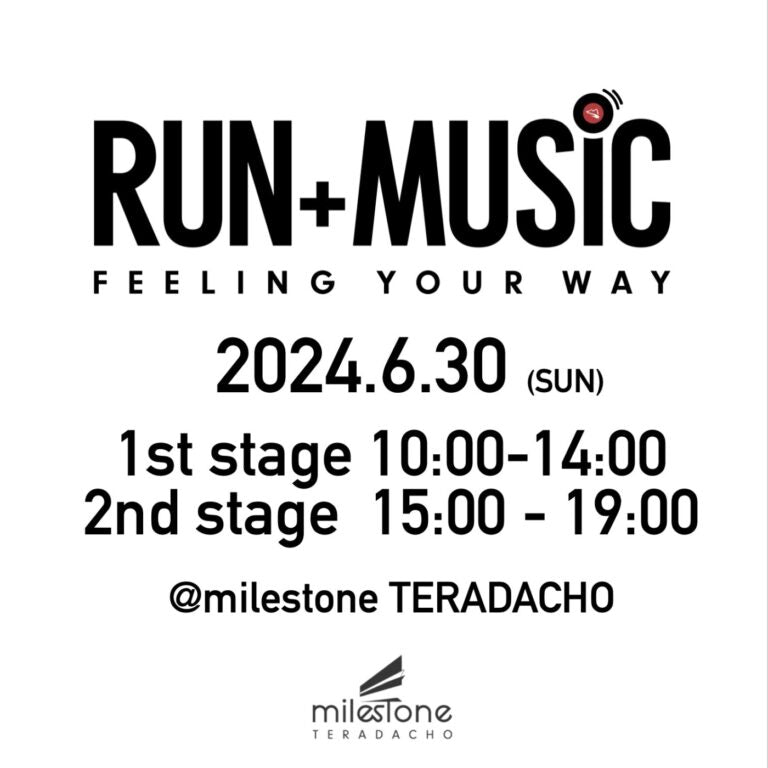
Nishi: So, today we're announcing our first anniversary event. It's also the 10th anniversary of the brand, and June 30th marks exactly one year since milestone TERADACHO opened last year.

Nishi: We've reached our first anniversary, so we wanted to do something special. So, when we thought about what kind of event it would be, of course we wanted to do a run, but in this place, music came first.
Yoshi: There's space on the first floor and there's a DJ booth.
Nishi: I thought it was possible. So I thought about who to invite and what kind of atmosphere to create. I used to be a musician myself, so I thought it would be one thing to invite some fellow musicians, but I also wanted to invite people who could empathize with milestone 's customers and users. As I was running with that in mind, something clicked. I've already announced it, so you probably already know, but it's Ishikawa Hiroki, the pioneer who brought trail running back to Japan.

Hagi: No way (laughs)
Nishi: I knew he loved music, so I offered him the job without much thought. There had been many talk shows and running events in the past where he had been invited as a trail runner, but I thought that no one else would think of inviting him as a DJ.
Yoshi: It's El Dragon of the world.
Nishi: Thank you so much for accepting me. I'm so grateful. Hiroki Ishikawa is coming to Teradacho.
Yoshi: As a DJ (laughs)
Nishi: Above all, I want Hiroki to have fun. I'll be DJing too, but I don't think the fun will be conveyed to the audience unless we're having fun. Rather than worrying about what kind of audience will come or what songs will suit them, I want you to play what you think is good. I told him that I want Hiroki to have fun. And so I thought that if I did that, it might work.
Hagi: I want to see you dancing too!
Nishi: And then I thought that having one more person would make the balance better, and the first person that came to mind was Kuwahara Kei, the owner of the Tokyo trail running shop Run boys! Run girls!.

Hagi: Oh!
Nishi: Kei-san is a client of mine, so I visit his shop a few times a year to do business with him, and when I do, we spend about two hours talking about music (laughs). He knows a lot about current music. He always plays great background music in his shop. I asked him what it was, and he told me he plays a German radio station.
Yoshi: Wow.
Nishi: At another time, when I had an exhibition in Tokyo, I made an appointment with Kei and asked him if he would be interested in DJing at the milestone TERADACHO 1st anniversary party. He immediately replied, "Sure!"
Nishi: Actually, I told Hiroki right away that I had made an offer to him. We're also connected through futsal. We're both one year older than me, so we're roughly the same generation. In terms of our trail running experience, though, we're completely different.
Nishi: Today we will be video chatting with these two special guests.
Hagi: What!
・From music to trail running
(Video chat begins)

Nishi: Good evening! Nice to meet you. I'd like to ask you a few questions today.
Nishi: The first time I met Hiroki was...
I think I spoke to Hiroki Ishikawa (hereafter referred to as Ishi) at the RUN WALK Style shop in Osaka.

Nishi: I was impressed by a promotional video that Hiroki appeared in that started with a record spinning. I read somewhere that he used to have dreadlocks and loved reggae, so as a music lover, I thought that if I could fit in with that, people would remember me, so I spoke about it.

Ishihara: I remember talking about that more than about orchids. (laughs)
Nishi: That's right. I think the first time I met you was when you went to the store to do business.
Kuwahara Kei (hereinafter, Kuwa): There was a time when our booths were next to each other at Three Peaks.
Nishi: Yes, there was! Whenever I go out on sales calls with Kei, we always talk about what kind of music I've been listening to recently, and we only talk a little bit about work at the end. Kei has an incredibly wide antenna, he's got an incredible range of genres. He'll say things like, "This beatboxing is interesting," or "These young Japanese rappers are hot right now." About 90 % of the time we talk about music.

Ishi: Oh, so that's how it is.
Kuwa: I'm happy because there aren't many people in the trail running community who I can talk to about this sort of thing.
Nishi: I'm glad you think so. Actually, I think that style is fine. Because it would be weird to just suddenly put a new product on a table and ask people to order, haha. I always talk frankly. So when I met Hiroki, we got closer by talking about music rather than running, so I asked him to join us this time.
Nishi: Well, let's get started. I have a few questions for you two today. This is probably not a question you'd normally be asked, but could you tell me what first got you interested in music?
Ishi: Before I started trail running, I wanted to play soccer in the future, so I entered university through soccer. One day, an upperclassman at university took me to a reggae club called Afromania in Aoyama. I was just starting to fade away from soccer at the time, so music really got into me. From there, I continued to play soccer, but I also started listening to all kinds of music, mainly reggae. Since it was back then, I started collecting records. I found it fascinating to discover the latest music being played in clubs, with songs that had certain rhythms and atmospheres. If there was a song I didn't know, I'd want to ask the DJ directly, so I always carried a small notebook and pen in my pocket and would ask, "What song was that?" before heading home. That was my club-going style.

Nishi: Notebook and pen! Analog (laughs)
Ishi: I started collecting records when I was around 20 or 21. I worked part-time at an izakaya, participated in club activities, and was involved in music clubs, spending my part-time earnings on records. I was living in a boarding house in Mishuku, where there was a club called WEB . I thought I might as well get a job if I was going there so often, so I worked as a cashier and waiter there, and occasionally played in between the main DJs for short periods. A customer I became friends with at the club asked me, "Ishikawa, you play soccer, right? Come help us out." He was a music writer, but his team included people from fashion and various other industries, including the first Japanese person to compete in an adventure race. His name was Ken Tanaka, and he runs a campground called Outside Base in Kitakaruizawa.

Nishi: I know that. You're an ambassador for Coleman, right?
Ishi: Ken played soccer in high school. He runs, bikes, climbs, and even kayaks. I thought there was an amazing world out there. I wanted to take part in an adventure race someday, so instead of running to train for soccer, I started running for myself. I thought running was fun, so I started jogging and then participating in amateur races. Ken, along with model/outdoor essayist Tokichi Kimura, who invited him to adventure races, and Takashi Tanaka, were both buyers for outdoor and fitness products at the time. I met these people. Kimura lived near Lake Kawaguchi, so he said, "Come visit me sometime," and we decided to go for a run in the mountains, and that was my first experience of trail running.
Nishi: A sea of trees?!
Ishi: From there, I wanted to take part in an adventure race one day, so I bought a mountain bike with my part-time job earnings, went to a climbing gym, and was taken kayaking and canoeing. I went to university for five years, but in 1998 , my fifth year, with only my thesis left to complete, I traveled around the US by bicycle and started competing in races during that time. My first race was a trail running race in Utah, which I stopped at during my trip. After that, a friend invited me to participate in Hasetsune, but I withdrew in 1998 , and then returned the following year in 1999 , coming in second place.
Nishi: What was Kei's first race?
Kuwa: The first time was in 2011 when I ran 5 or 6 kilometers in the relay race at the Sugadaira Trail Running Race. I had formed a team called Trail Toba-chan, and one of the members found me and said, "Let's enter this race."
Nishi: Did you feel like you increased the distance from there?
Kuwa: I started trail running in 2011 , and in the fall, when I started participating in races here and there, I read " Born to Run : Ultra Runners vs. the Strongest Running Tribe in Humanity" (Christopher McDougall, NHK Publishing) and found it very interesting. I saw that Matsushima Michiaki, the editor of the Japanese edition, was featured in an online media called "On Your Mark ," so I asked Matsuda, who edited the media, "I'd love to meet you someday, so please arrange it." Then, at the drinking party, I wanted to talk to Matsushima, but someone named Yamada Hiroshi, whom I'd never met before, kept talking. At first, I was thinking, "I want to talk to Matsushima," but Yamada said to me, "Next year, there's UTMF , so I'll run the 100- mile race, but you have a half marathon category called STY , so why don't you run it?" At first, I said I couldn't possibly do a 90km race after being invited out of the blue, but as I watched Yamada talk about the race with such enthusiasm, I began to feel drawn to the tough mentality of trail runners, and although it was a bit of a challenge, I decided to give it a try and entered. That was the first UTMF/STY , which was postponed due to the earthquake. Before that, I ran in a race on the ancient roads of Kumano in March as practice. Incidentally, Yamada Hiroshi had secretly participated in last year's BAMBI100 .
Nishi: What was Hiroki's first 100- mile race?
Ishi: It was the Western States Endurance Race in 2002. I'd run long distances in adventure races, a multi-disciplinary sport, but that was my first trail-only race. From February to March of that year, I traveled to the US almost every week to race, as a kind of training. I figured I'd be fine running since I was doing adventure races, so I ran 50km , 50km , 80km in a row. But then, around April , I developed iliotibial band syndrome. I had no idea what was going on, like, what's this? I arrived at the race in June without having had much time to train. I was hoping to finish in under 24 hours, but despite the pain of blisters on my feet and blisters inside the blisters, I managed to finish in just 23 hours and 40 minutes.

Kuwa: The 24- hour version has a silver buckle.
Ishi: I also met Scott Jurek.
Kuwa: Are you on a seven- game winning streak?
Ishi: That was my third win. Before that, I spotted him before the start of a 50km race, and we competed and I won. But in the 100- mile race, I was 7 or 8 hours behind him. It made me realize that the 100- mile race is a completely different category.
Nishi: What was Kei's first 100- mile race?
Kuwa: In the fall of 2012 , there was a hellish race called the OSJ Yatsugatake Super Trail, and I was persuaded by Yamada Hiroshi to do it too. But it was so cold at the 100km mark that I got sucked into a bonfire and had to give up. My next challenge was the 2013 UTMB. I was also a member of Kaburagi-san's Team 100 Mile, and I was in the slower Tortoise category, not the Rabbit category, but I'd improved a lot in about six months. I set off for Chamonix thinking I could do it, but then I got bronchitis just before the race and couldn't breathe, so I had to quit around the 30km mark. I struggled to finish, so the following year in 2014 , I finally completed the UTMF for the first time. That time too, I stuck my foot in a big hole in the trail at the 50km mark and badly sprained my ankle, but I was determined to finish. It was my third race, and I finally did.
Nishi: Hearing about your battle history, I realize I'm still just an amateur, and in terms of entertainment experience, it's Kuwabara "Big Brother" and Hiroki "Master." As for the order of DJs this time, I'll be the first to take the lead, even though I've only been trail running for less than five years. My first 100- mile run was last year. Master!
Kuwa: I'll study first!
Ishi: You can't do anything bad (laughs).

・Early experiences with music
Nishi: As the day of the event approached, I double-checked the system to see how the sound would play, and checked how high the volume could go without disturbing the neighbors, all while feeling a bit nervous. I also had two turntables and a PC DJ , so I thought I'd need a mixer, and pulled out the digital mixer I used to play music at my parents' house. I turned it on for the first time in 20 years, and it worked just fine. I also had music from 20 years ago saved on it, so I listened to it for the first time in a while and it was amazing (laughs).

Ishi: Haven't the knobs deteriorated? (laughs)
Nishi: It was okay (laughs). We were able to record the entire event this time as well.
Nishi: When did you start to like music, Kei?

Kuwa: I started listening to a lot of different things when I was in high school, and when I entered university I was into Japanese rap acts like Scha Dara Parr and King Giddra.I also had a classmate at university called Higo, who now runs Merry Joy Records and is also Trail Toba's teammate.He was a big influence on me as I started listening to Japanese hip hop.
Nishi: Seriously?! On a side note, the members of LIVING LEGENDS, who I used to make music with in America, also released works on Merry Joy.

Kuwa: After I started working, I started listening to a wider range of music, and at the age of 26 I started my own business and opened a futsal field. Before that, when I was working part-time, Masaya from JAZZT SPORT came to the futsal field every week.

Nishi: Fantasista!
Kuwa: We became good friends and I started going to his events. He played cool jazzy hip hop and jazz-leaning tunes, so I felt like my range expanded from there.

(Photo) Kanye West, also known as "Ye," is well known for his collaboration with Adidas, YEEZY. Although he's been causing quite a stir recently, he's also an incredibly cool track maker and rapper.
Nishi: I see. Going back even further, what was the first CD you ever bought?
Kuwa: I think it's Nakayama Miho's single.
Nishi: What song? (laughs)
Kuwa: I think it's "You're Lucky, You're On a Roll" (released August 1986 ).
Ishihara: For me, it was Seikima -II 's single (little textbook) "House of Wax Dolls" (released in April 1986 ). My cousin let me listen to it in the car, and I thought Demon Kogure's voice was cool even for an elementary school kid. The lyrics were unique, though.
Nishi: I'll check again. So what was the first Western music you bought?
Kuwa: When I was in my third year of junior high school, there was a Dance Koshien. The song they played there was " Now that we found love " by Heavy D & the Boyz.

Nishi: No doubt about it!
Mulberry: Now, we, find, love, we, are, we, gonna, do~ ♪
Nishi: That's a classic. We'll play it on the day, so please dance along (laughs).
Ishi: I have a reggae cover.
Nishi: That original is a 70s song by The O'Jays. What about your Western music?
Ishihara: I think it was probably Bon Jovi. I was in the Yomiuri Club in junior high school, and we would play their music at full volume on the bus when we were traveling, and we'd all go to the games with high energy. I was in my first or second year of junior high school. I can't remember the name of the song though.
Nishi: There are so many great songs. By the way, the first Japanese music I bought was Ziggy's "Gloria."
Kuwa: I think it was the theme song for a Monday 9pm drama.
Nishi: The Western song is "HOLD ON" by Wilson Phillips, the trio of Beach Boys' daughters. YouTube:

Ishihara: It's a love song for me. A girl I was dating in high school recommended it to me.
Nishi: It's an incredibly good song. You don't hear this kind of thing very often.
Ishi: It's connected to music. It brings back memories of the past.
Nishi: It reminds me of old love affairs (laughs).
Nishi: Do you still buy music?
Kuwa: I don't buy much anymore. I just pay for Spotify . PCDJ doesn't support Spotify , so I'm thinking of signing up for Apple Music separately.
Ishihara: I use iTunes almost exclusively, but I do buy two or three records a year on Yahoo! Auctions and Mercari.
Nishi: Hiroki, you use Mercari and stuff like that (laughs).
Ishi: I also buy old Patagonia items (laughs).
Nishi: There's love there (laughs). What was the first live music performance you saw?
Ishihara: I think it was the reggae Sunsplash or Christmas Splash that I saw in Makuhari, where you can do indoor skiing.
Kuwa: That's Zeus (located in Funabashi City, Chiba Prefecture).
Kuwa: I think the first live show I went to was to help out at Higo-kun's event. It was in front of Sanpin Camp , around the time Buddha Brand had just returned to Japan. There were acts like Rip Slyme, who hadn't even made their major label debut yet, BY PHAR THE DOPEST ( KREVA 's pre- KICK THE CAN CREW) and SOUL SCREAM performing, and it was a show that showed Japanese rap starting to take off from the underground.

Nishi: Kei-san knows quite a bit of Japanese rap, so we always have great conversations.
Ishi: That's intense (laughs). And it feels like you're connected to the artist.
Kuwa: Most of the time, we just happened to be in the same class or at the same futsal field.
Ishi: What about Nishioka?
Nishi: I think it was Hamada Shogo's "ON THE ROAD TOUR" that I got into in middle school. lol
N: If you could have a front row VIP seat, whose live performance would you like to see?
Ishihara: I'd like to go for Bob Marley or something. Maybe Marvin Gaye. The first record I bought was by Marvin Gaye.
Kuwa: It's not hip-hop, but I really love Nirvana's unplugged live shows. I'd love to be in the front row at one of those shows. It's a very moving concert, with a sense of the composure of Kurt Cobain in his later years, and a sense of him having mellowed out.
Nishi: The MTV Unplugged projects have a live feel to them, which is great. The Eric Clapton one is also cool.
・Experience your body moving
Nishi: What did you think when you received this offer?

Kuwa: I have absolutely no experience as a DJ, so I felt like I was given a great opportunity. I'm almost 50 and I'm not starting anything new, so I felt like I was given a great chance with someone I know well.
Ishi: I thought I could play it at a loud volume. I wondered if people would listen to my favorite songs through earphones, headphones, or speakers that weren't the sound I usually listen to.
Nishi: Thank you for accepting. What genre of music are you planning to play this time?
Kuwa: This is my first time as a DJ, so I've included songs from all genres that I've listened to in the past that I like. I'm listening back to them now, and I think the songs that stick in my memory are good to listen to now too. I made the playlist, and it took about five hours (laughs), so I'm thinking of narrowing it down from there.

Ishihara: I love 90s dancehall and lovers. I'll be playing covers of various genres, and even though some people might not know anything about reggae, I hope they'll think they've heard this song and think it's a good reggae song, so I'll be playing mainly those kinds of songs.

Nishi: It's easy to get into. I think it's comfortable when familiar songs are set to a reggae rhythm. My music is split into two parts, hip hop and jazz/soul, so I'm thinking about doing it separately. I'm a little worried that if I make it hip hop, it will be difficult to mix.
Ishihara: I'll just bring some songs I like and see what the atmosphere is like. I think Nishioka should be the final act in the second act.
Nishi: No, no. I only ran 100 miles last year (laughs). I need my master to finish me off.
Ishi: I feel like reggae is probably the genre with the most people who don't know anything about it.
Kuwa: Well, there are a lot of songs I'm planning to play that people probably don't even know about. But I'd be happy if they thought it was cool. Even if it turned out like this song.
Nishi: Maybe some people even brought notebooks and pens (laughs).
Kuwa: When we had a futsal field, we also had a cafe next door, and we used to invite artists like Jajispo, Cro-Magnon, and Special Others to perform there, but there weren't many people who could enjoy both. Futsal players would like futsal, and music lovers would like music, and of course people who like both would think, "This is the best event!" This time, it might be an opportunity to connect trail runners and music lovers, and I hope that even people who don't normally listen to music will just enjoy it without worrying about it. Whether they know the songs or not, I hope they'll just enjoy it without any pressure, thinking, "This is kind of nice," "I didn't know the melody before, but it's a good one," or "It feels good."
Ishi: I hope that music lovers will get into it and enjoy it, and that they will have the experience of hearing new music that gets their body moving and swaying, and discover a new world.
Nishi: Well, that's all for today. I look forward to working with you on the day!
(Video chat ends)
Nishi: I'm the one looking forward to it the most. It's not often that you get to see Ishikawa Hiroki DJ , so I wonder what kind of songs he'll play. I'm so happy that it's finally happening. The title this time is " RUN+MUSIC ", an homage to the well-known trail running magazine " RUN+TRAIL ", and we've paid homage to it by using a similar logo, but with a slight twist. Editor-in-Chief Suzuki has also given us his approval.

Nishi: We took the milestone slogan " LIGHTING YOUR WAY " and added the subtitle " FEELING YOUR WAY ." At first we thought about making it " LISTENING YOUR WAY ," but we also have a run the day before, so it's more of a pre-event. We'll also be running on the evening of Saturday, June 29th , as a special edition of the Teradacho Jogging Club, which is held on the third Thursday of every month.
Nishi: Thanks to everyone's support, the Saturday jogging event is almost fully booked, but there are still spaces available for the Sunday event. There's no particular dress code, so feel free to invite your friends and come along! Enter here → https://moshicom.com/106702/

Nishi: I'd like to get more music lovers involved in the future, and let them know what they can do, or what sounds good. Of course it doesn't have to be black music. I'd love to do something outdoors someday. I'd love to create a space with GOOD VIBES ONLY, where we can run in the mountains, listen to music, drink beer and have fun.
Hagi: That's great!
Yoshi: Everyone works hard at trail running, but when you change the focus to music, it becomes more even-keeled, which I think is interesting. At Teradacho Jogging Club, when we talk about our favorite foods or other hobbies, it resets the relationships between everyone, which I think is great.

Nishi: Maybe people who like music will become interested in trail running. If we keep doing interesting things, I'm sure there will be people who want to join in, and if it's well-received, I'd like to do it again next year.
Yoshi: We'll be waiting for you at milestone TARADACHO .
Nishi: Well, that's all for today.
Nishi, Yoshi, Hagi: Goodbye, goodbye, goodbye.
This time, we had the opportunity to hear from two special guests at the milestone TARADACHO 1st anniversary event " RUN+MUSIC " at the end of the month. They shared a lot of unique stories about their musical experiences and trail running.
When I first started trail running, the first book I picked up was "Enjoying Trail Running" (Chikyumaru) by Hiroki Ishikawa. Then I actually experienced it at a workshop held by Ishikawa. I never thought I would see a day like this.
Speaking of which, it seems that Yoshida, the manager of milestone TARADACHO , was once a dreadlocked band member.
Continue at your leisure in Teradacho.
Text and composition: Ken Hagiwara
Share :
Episode 17: Tell Me! Milestone "A New Dawn"
Episode 19: Tell Me! Milestone "The Afterglow of Music and the Next Run"