

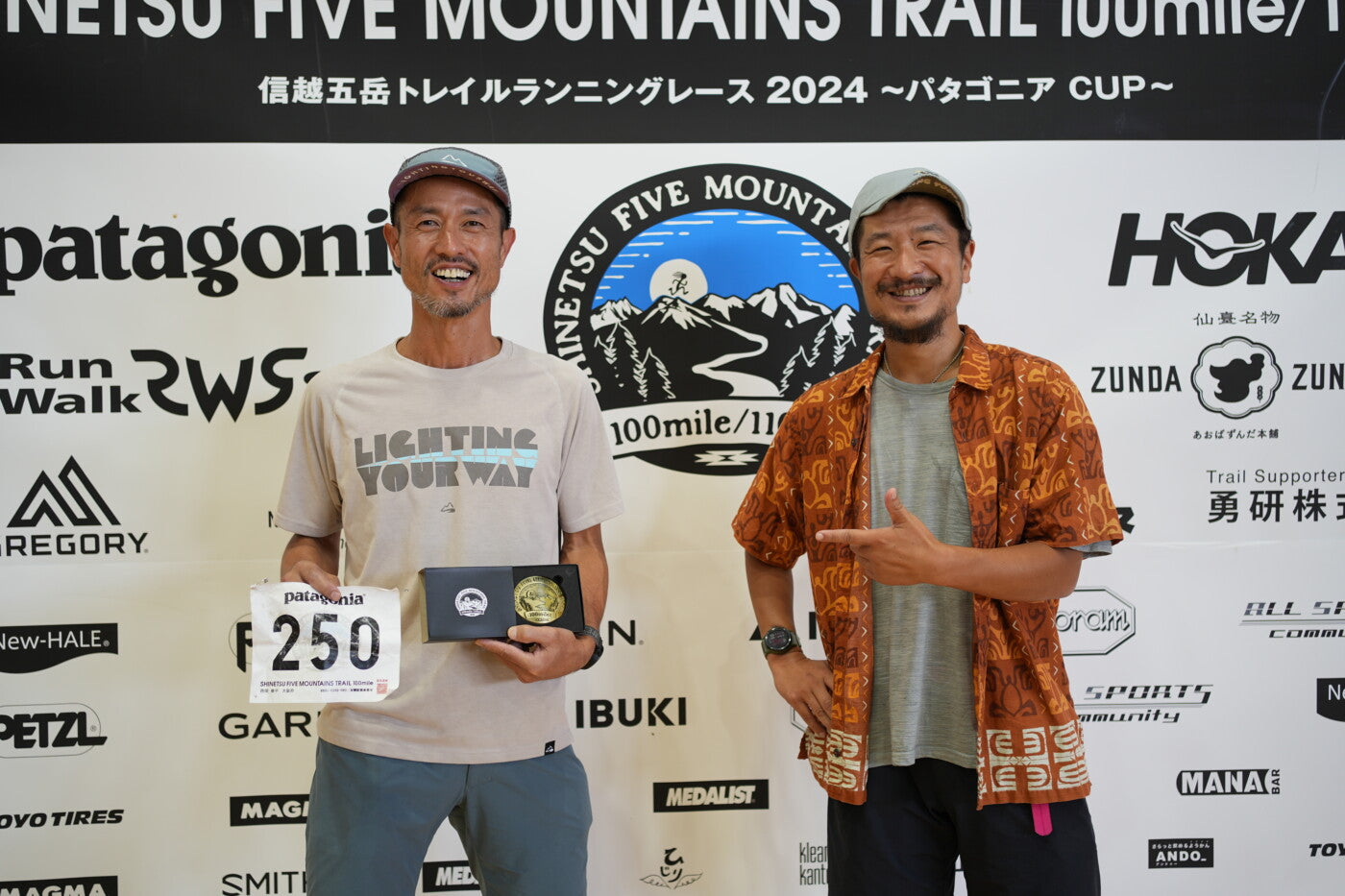
Hello everyone. How are you? I went to the Shinetsu Gogaku Trail Running Race 2024, which was held last weekend.

After checking in, we took a commemorative photo with the members who accompanied us this time.

Left → Right: Norio, Maki, Ito-chan, Nishioka, Yoshi, Haruka, Yamanenko.
Before I get into the main topic... we left Osaka early in the morning with plenty of time to spare, but suddenly trouble occurred. There was an accident in a highway tunnel. What's more, it was about five cars ahead of us, and the situation was quite serious. Emergency vehicles were gathering one after another and seemed to be performing rescue operations. We were caught in a completely stuck traffic jam.

I had no choice but to make a U-turn inside the tunnel and take a different route.

To my surprise, Google recommended the Toyama route. Since the reception was open until 2:00 PM, I hurried to my destination.

I was surprised to find myself on the Sea of Japan. Lol. I somehow managed to arrive at my destination in time and check in. I finished the check-in at 2:00 PM and got my tape done at New-Hale, who I always use.

I replenished my stamina. I almost finished it, even though I said, "No, no, that's not the amount I should eat before the race!" 3 hours before the start

After leaving my drop bag, I took a commemorative photo with the members of Wednesday Budouzaka who I always run with and who are also participating in the 100-mile course.

I was able to talk to many people at the venue, meet some acquaintances I hadn't seen in a while, and even spoke to some people during the race, so it was a really fun, but also quite difficult, run.

At the starting point, I didn't want to get stuck in traffic, so I took pole position in the middle and moved slowly. Then, I met Shiitake-kun (Okamoto-kun), a shiitake farmer, and we started talking and proceeded together.
(As an aside, Shiitake is a very strong runner, having passed the TJAR selection process. He is so strong that he is aiming to finish in under 24 hours at this tournament. He also regularly makes guest appearances in milestone catalogues.)

This was the start of a big mistake. I barely walked to the first aid station, Arasehara, and ended up running. And at a good pace.
After that, I passed through Banff and made it to the first aid station, APA, but my legs were completely worn out. This was the first major point. I asked myself if I could run another 110 kilometers.
Then I heard a voice deep inside me say, 'No, you'll never be able to do that.'
I had heard that a 100-mile race starts at the 100km mark, but honestly, I never imagined I'd be in this condition at the 50km mark.
We suddenly slowed our pace, passed the second checkpoint, the National Myoko Youth Nature House, and after going through some tough climbs and descents, arrived at the second major point, Ikenodaira Sports Plaza, at the 87km mark.

An acquaintance of mine provided me with some non-alcoholic drinks.
Completely exhausted by the heat and the climb, I found myself thinking only negative thoughts. "I can't do this anymore." I collapsed onto the large grass field. Sensing I'd reached my limit, I video chatted on LINE with Yoshi, my pacer, who was waiting for me at the next aid station. I tried to explain my situation, but the signal was poor, so I texted him the three letters "DNF" (short for Did Not Finish, meaning I had withdrawn from the race).
Yoshi then calls and tells him that there is still plenty of time and that it is too early to give up. He asks him to think about it after getting some sleep, but he tells him that he will head there by bus.
The runners behind me were passing by one after the other. An acquaintance of mine was also suffering from stomach problems, but said he was heading to the Kurohime aid station, 12 kilometers away.
I decided to clear my mind a bit, pour water over my head, and start again.
It may sound like an exaggeration, but I felt like I was reaching my limits. Believing that if I moved forward slowly, step by step, I would arrive first, I finally arrived at the Kurohime aid station where pacer Yoshi was waiting.

We finally reach the top, but the letter “X” appears, signaling we’ve reached our limit.
Yoshi tries to explain how he's pushed past his breaking point, but he only stays there for 30 minutes.
Eat well and get some rest. I put down my backpack and collapsed onto the blue tarp.

Maybe my stomach is damaged, but I have no appetite, but I try eating porridge and fruit jelly.

To refresh myself, I changed clothes and had a massage.

"Ah, it's so hard. I can't do this anymore. I've reached my limit," I repeated, but Yoshi, our pacer, said, "It's okay. Let's move forward slowly."
We then headed towards Sasaga Mine, the next turning point. It was beginning to drizzle, but I didn't wear a raincoat to prevent overheating. I leaned on Yoshi's shoulder and walked slowly up the climb. Having run 100km alone up until now, I was reminded of the importance of being able to run (walk) while having a conversation with someone.
Ah, this is tiring. How long is this climb going to last? I kept repeating this to myself as I continued on. It started to rain quite heavily on the forest road descent before arriving at Sasaga Mine. There was a traffic jam on the bridge that only two people could cross at a time.
The trail surface was getting muddier and muddier. Normally, I would be able to run smoothly, but my feet were bogged down and I couldn't move forward as I wanted. With the rain being an unavoidable force, I began to worry that I might not make it in time.

When I asked Yoshi, "Will we make it to the finish line at this pace?" he answered confidently, "Yes, we'll be fine." So I decided to leave it to him with peace of mind. I just focused on moving my legs forward.
Although the steep climb before the Sasaga Mine aid station was slow, we managed to reach the top.
It was raining quite heavily when I arrived at Sasaga Mine, the 111km mark. It looked like the runners who had arrived earlier were stuck. Yoshi brought me curry and consommé soup. It was the first time I had eaten something warm since the start of the race. I ate it so deliciously that I could feel it seeping into my body. I then took my rain jacket out of my pack and went into battle mode. I stayed there for 8 minutes.
This aid work meant that he overtook about 30 runners.
We then decided that this was the perfect opportunity to test out the new rainwear that is scheduled to be released next year, and we continued talking about work. (As an aside, Yoshi often points out that I, Nishioka, am most energetic when talking about work, especially development.)
I can't go into too many details yet, but we both felt the good rain and made it to the next aid station, the West Trail Entrance. There was a sample of MAGMA here, so we quickly drank some and headed to the next aid station, the Ohashi Forest Road, also known as Patagonia Aid Station.
At this point, the rain was pretty heavy, with the trail turning into ponds and the amount of precipitation felt quite heavy. At Ohashi Forest Road, we had some miso soup and apple juice, and then headed for the next aid station, Togakushi. The RUN WALK Style team was providing aid here, and they also served soba noodles. Sergeant Yoshida gave us permission to take a longer break.
As we approached the finish line, I decided to change the battery in my headlamp as this was the last major aid station, but when I arrived, race director Hiroki Ishikawa himself was announcing to the incoming runners that due to bad weather, the race would be canceled at the Togakushi aid station at the 142km point.
I think we arrived at Togakushi around 9:47pm. We had planned to cover the remaining 20km in 5 hours, finishing in 32 hours (with an hour to spare at the checkpoint), but the trip was cancelled.

Looking around, I saw some players feeling frustrated and some crying. But in my case, I was relieved that it was going to be considered a goal and that it would end there.
I had been training hard for the Shinetsu Gogake Trail Running Race, and it turned out to be an unexpected turn of events, but considering the organization of the event, I think it was an excellent decision to make in that situation.
The Shinetsu Five Mountains will continue in the future, and many people have asked me if I'll take part in the next one, but I've had enough and I answer, "I've had enough."

So, what did you all think of the Shinetsu Five Mountains? Some runners made it to the finish line, some made it all the way to Togakushi, some didn't make it to the checkpoint, and some gave up along the way. I'm sure there were all kinds of experiences, but I was reminded once again that the Shinetsu Five Mountains Trail Running Race is fun, and a loving event filled with wonderful hospitality.

I would like to take this opportunity to express my sincere gratitude to the organizers, management, sponsoring manufacturers, and everyone involved.
I am also very grateful to everyone who sent me encouraging messages and gave me pep talks at the venue, to everyone at Budouzaka who I run with regularly, and to Yoshi who acted as my pacer. Thank you very much.

This equipment:
Cap: MSC-013 All White
Headlamp: MS-i1
Waist light: MS-i1 + RUSHLight 2.0 (scheduled for release in late March 2025)
Windshell: Onion Hoody (California Orange)
Rainwear: Up-Swing Rain Hoody, Up-Swing Rain Pants (scheduled for release in late February 2025)
T-shirt: DooBop Sleeveless (Brown)
Backpack: The North Face (TR10)
Shoes: Pentapetalla (Papilio)
Socks: MSS-003 Tabi-style socks, mist green
Shorts: Natty Shorts 3.0 (scheduled for release in February 2025)
Sunglasses: Owlmils (Izanagi)
Shade: Mont-bell
Equipment: dust pouch, hand towel

From Kurohime
Cap: MSC-015 Flip Logo Model (Not for sale)
T-shirt: DooBop Sleeveless (Blue)
Pants: NattyShorts 3.0 (scheduled for release in February 2025)
Socks: MSS-004 dayBreak Merino Socks (scheduled for release in Winter 2024)

The long-awaited completion buckle is on display in the milestone TERADACHO.

Share :
Ryo Doi's "Traverse of the Japanese Alps: Report Session" was a great success.
Famous shaved ice shop: Shima no Mono Cafe Tanakato was a great success.